Maker/Dealer
York
Grand Rapids, MI
USA
-
1839 James W. York
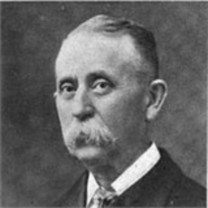
is born in Exeter, NH to musician father Ezekiel and wife Nancy (census)
1850 the York family is in Haverhill, MA (census)
1860 now in Biddeford, ME (census)
1861 James enlists in the army as a musician (CW records)
1863 James is discharged from the army
1867 James marries Josephine Swasey in Biddeford
1868 James is in Biddeford, ME; musician; son Frank Warren York is born on August 29th (birth record)
1872 James is working in Worcester, MA as a painter; son Charles Edwin York is born on December 2nd (birth record) 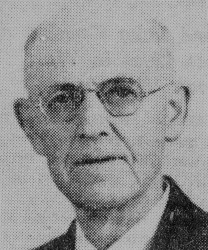
1870s despite numerous claims to York working for the Boston Musical Instrument Mfy., he is not found in any directory
1882 James moves to Grand Rapids, MI and opens a music store (1937 Grand Rapids Herald article says he started on lower Monroe Ave. where Heyman’s store now stands)
1883 York & Smith, #67 Canal St., James York &Christian J. Smith; music
1
1885 opened factory with Frank Holton on Canal St. (NLI)
1886 York & Holton, #57 Canal St., with Frank E. Holton; music & musical goods; Newell L. Thomas, engraver & William S. Bronson are working for them.
1887 In recognition of his infant son Charles E. York, he renamed the company York & Son.
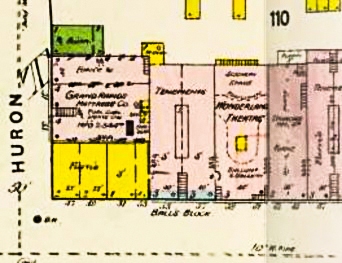
1888 Sanborn map of Canal St. shows #57 C as tenements
1887 now J. W. York & Son with Frank (age 19); the earliest instruments found so far have ˜York & Son˜™
1888 Sanborn map has the second floor of #3 Ionia Ave. marked ˜’Musical Instruments’™
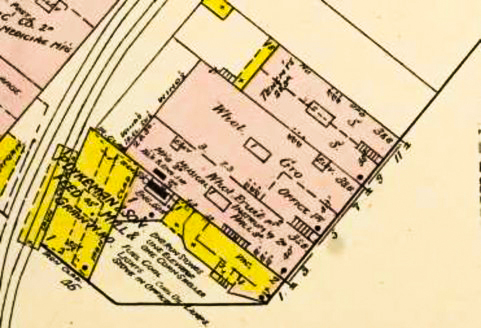
1889 J. W. York & Son, #3 North Ionia Ave., manufacturer of band instruments & music publisher; William Bronson is now listed as instrument maker.
1890 York is described as a repair plant that makes a few cornets and trombones (Grand Rapids Herald, 1937)
1894 8 men working at the factory (MI Dept. of Labor report)
1898 Alfred Johnson is working as a finisher, age 17
1898 J. W. York & Sons with Frank &Charles, #3 N. Ionia ; branch office in Chicago (ad); a complete line of brass is now made (1937 Grand Rapids Herald article)
1902 Henry Martin Sr & Jr are working at the York factory; Henry Jr is superintendent of the factory; they are making a new valve trombone (Music Trades)
1903 York is to move to the Raniville building at the corner of Campau & Lyon Sts., 11,000 sf on the 2nd floor, currently 60 now employed at the #3-7 North Ionia St. factory (Music Trades, July)
1903 debut of ’˜Professional’™ model cornet with Bb/A slide (Music Trades, August)
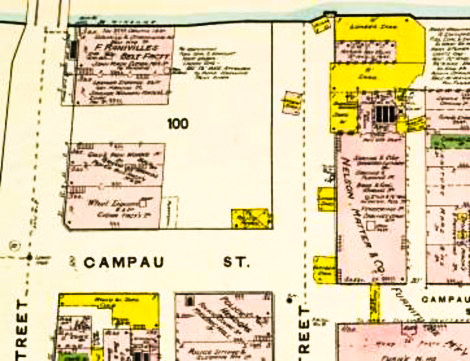
1903 York is now in larger quarters; the first six years were in small quarters on Canal St. then the last sixteen years on N. Ionia (about 1887); they had purchased a factory site on S. Division St. some time ago but conditions have not been favorable to build yet (Music Trades, August) Here is the Raniville site mentioned in 1903. This view is from 1888 showing the Raniville Belt Factory. By the 1895 Sanborn map, we can see the large building on the corner of Campau & Lyon Streets that York moved to.
York now fully in new factory; York &˜Musical Herald™ was just issued (Music Trades, November)
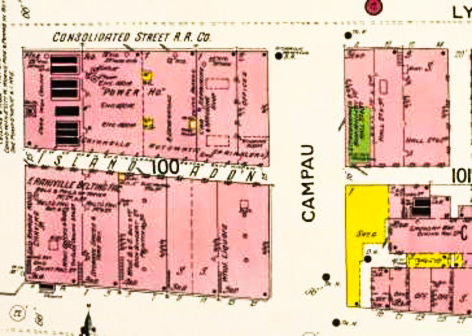
1904 York at #2-20 Lyon St.; George Jackson recently joined the company (Music Trades, April)
1905 York had to re-occupy the old Ionia factory to build cases and drums (Music Trades, March).
York adds to their factory which is devoted to brass and silverplate band instruments; they now have 100 employees (Music Trades, July)
1906 York is incorporated (Grand Rapids Herald, 1940)
1908 York moves into their new factory at #1600 S. Division St. (photo 1 at right); they have 130 employees making 300 instruments per month (Grand Rapids Press, December)

1909 Edward J. Butler is granted patent #916,530 with assignment to York & Sons; tubing bender machine
1910 Alfred Johnson is granted patent #963,768 with assignment to York & Sons, High/Low pitch slide; Frank W. York is secretary & treasurer of York; Charles is listed as band instrument manufacturer (census)
1911 the Grand Rapids Band Instrument Co. is established, same owners and address as York (1917 Michigan factory inspection report); James pres, Charles vp, Frank sec.. The Grand Rapids Band Instrument Company, a subsidiary of York, had its own serial number sequence and are not consistent with those of York from the same time period.
1912 Alfred Johnson is granted design patent #42,919 with the assignment to York & Sons, cornet design (photo 2) (photos 3 & 6 are similar and often labeled as ’˜Perfectone»™)
1913 Edwin S. Conrad & Charles P. Shepherd are granted patent #1,055,445 with the assignment to Grand Rapids Band Inst. Co., valve spring design. Alfred Johnson is granted design patent #45,091 with the assignment to York &Sons, Al-Tru cornet design (photo 4)/, York announces that by May they have made 60,000 instruments since their beginning (The Metronome); they also show the ’˜Metropolitan&rwquo;™ trumpet in an ad
1913 John & James Duffy along with Alfred Johnson form a stockholding company and purchase York & Sons
1914-1916 E. A. Couturier is a consultant in cornet design (photo 5 is the Couturier model)
1916 James York is still listed as a band inst. manuf.; James Duffy is York president, John Duffy tres, James F. Campbell sec.
1917 James York retires and moves to California. Up to this time, York specialized in Cornets and Trombones. The Michigan factory inspection lists York & Sons with 118 total workers &established in 1882; Grand Rapids Band Inst. Co. has 22 workers & established in 1911
1919 the Michigan factory inspection lists York & Sons with 245 workers, 69 of whom are women
1920 the Michigan factory inspection lists York & Sons with 283 total workers, 86 of whom are women; Charles York is listed as Violin factory president in GR (census)
1922 York and Grand Rapids Band Inst. Co. share the same address.
1923 still listed as J. W. York & Sons
1924 Ross Hickernell patents a trumpet design and has them produced by York; serial numbers are in the 3300 to 3800 range so do not match with regular numbers
1926 now listed as York Band Instrument Co. after York family relinquishes all interest; this name change comes between January and October (patents)
1927 James York dies in LA on August 2nd
1928 Alfred Johnson is granted patent #1,674,398 with the assignment to York & Sons for valve design (photo 1); he is also granted patent #1,673,195 for a sax tone hole
1929 Johnson is granted patent #1,735,576 for sax key stop.
1930 Grand Rapids Band Inst. Co. no longer appears in the city directory
1931 Johnson is granted patent #1,789,589 with the assignment to York Band Inst. Co. for trombone slide; Johnson granted patent #1,821,641 for a spiral valve design (photo 2); also granted #1,826,077 for drawing tubing
1933 Johnson is granted patent #1,922,685 for valve design
1937 Karl B. Shrinkman is pres &treas, Alfred Johnson is vice-pres, L. E. Butler is sec. (Grand Rapids Herald)
1940 Johnson is granted design patent #119,755 for the York Air Flow trumpet.
2
(drawing &photos at right); Charles York is retired and living in Ft. Lauderdale, FL (census). York is sold to Carl Fischer Musical Instruments in December for $300,000, they currently have 90 workers and plans are to double capacity (Grand Rapids Herald). Johnson left the company. During World War II the company manufactured munitions. After the war, York produced a student-line of instruments.
1951 York now has 120 workers (Grand Rapids Press, 1971)
1953 serial #186549 is sold.
1956-1959 York makes 75th anniversary models.
1970 York is sold to Tolchin Instrument Co. and the factory is closed (Grand Rapids Press, 1971).
1972 the York office moves from 1600 N. Division to #615 Griswold St., Detroit.
1973 now York Musical Instrument Co. Inc., #55 Marcus Drive, Melville, NY.
1976 York is sold to Boosey &Hawkes.
1998, the York name was acquired by the Brook Mays Music Company of Dallas, Texas. And, although, they advertised that the instruments were off-shore manufactured for them to precise standards.
2006 York filed for bankruptcy in July and closed in August
Extra Documentation
Contributions
Contribute new Data (or Corrections):
Information posted here will be added to this page.
This is not the place to ask questions, as users will only occasionally visit a particular Maker's
page. Pease use the forum to ask questions or talk about your instrument.
(Please use the forum for discussions, questions, etc.)