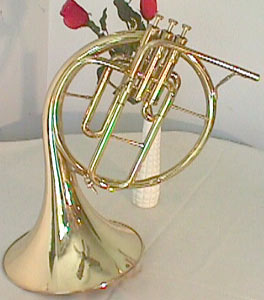
| ID |
Instrument |
Maker |
Model |
Serial# |
Manuf. Date |
Key/Pitch |
Click on Picture to Enlarge |
| 6991 |
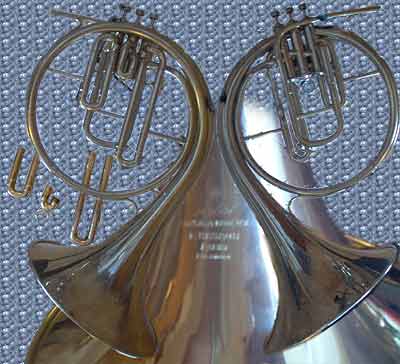
Tenor Cor |
Besson |
|
|
|
|
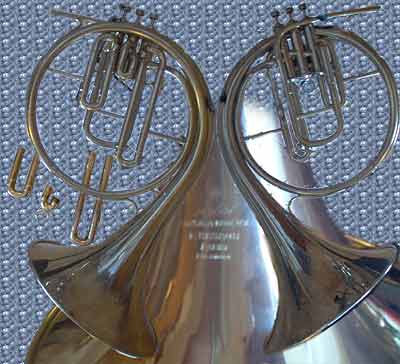 |
| Engraved:
Artist |
FABRICATION FRANÇAISE |
F. BESSON |
PARIS |
MADE IN FRANCE
|
| 1294 |
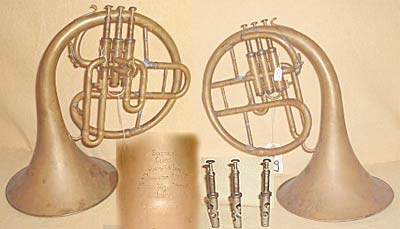
Tenor Cor |
Hawkes |
|
|
|
|
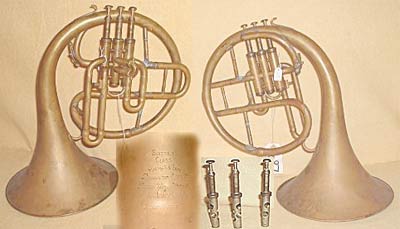 |
| Engraved: Superior class Hawkes & son Denman Street Piccadilly Circus London.
bell10 3/8 in
|
| 1042 |
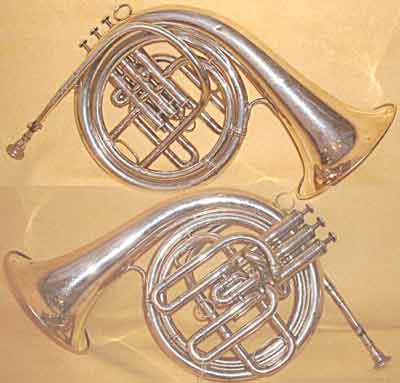
Tenor Cor |
Boosey |
|
35013 |
1888 |
|
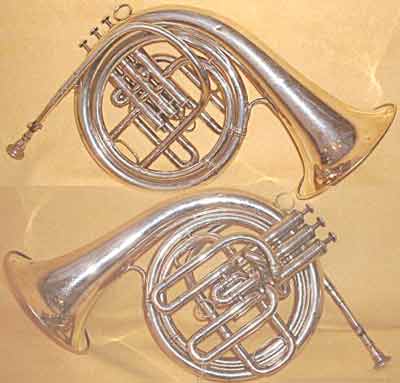 |
| Engraved: class A trademark Boosey patent compensating pistons Boosey & Co 295 Regent st London
gsmonks: This is a bass ballad horn in C, not a tenor cor. Though its called a "bass" horn, its really in the same range as the trombone/baritone/euphonium. Its also a Boosey & Co. instrument, not a Boosey & Hawkes instrument.
These horns were invented by Henry Distin who sold the patent and his outfit to Boosey & Co. in 1868. Boosey subsequently came out with a bell-up version of these horns in SAB, the bass actually being a tenor instrument. The soprano instrument was played using a "French" horn mouthpiece and was refered to as liedhorn.
Distin seems to have kept the patent to the bell-down "bass" version of his ballad horn, and I suspect that he was able to do this because the patent itself was erronious, as the Distin ballad horn was a knockoff of the 1855 Antoine Courtois Koenig horn. The earliest mellophone, made by Kohler & Son ca the late 1870s was likewise a knockoff, so no patent there either. The Kohler mellophone was a knockoff of the Distin ballad horn, so it was a knockoff of a knockoff.
These horns are flugle instruments, as you can tell by the deep V cup mouthpiece used to play them and the fat, in some cases rimless, conical bell. This entire family of related instruments was a Franco-Belgian response to the Germanic flugle instruments which were popular in the 1840s.
If you compare the bore-profile of the Koenig horn, Ballad horn and early Mellophone to the instruments made by Leipzig instrument builder Johann Joseph Schneider and Viennese instrument-builder Leopold Uhlmann, you will see that the Franco-Belgian instruments were an adaptation (you have to click on the "tenor horn 19 jh" link in order to see the photo):
http://translate.google.com/translate?hl=en&sl=de&u=http://www.uni-leipzig.de/~m...
Here is an 1874 version of that same Distin bell-down Ballad horn. I almost bought this horn when it came up for sale:
http://www.brasszone.com/booseyballadhorn14229.htm
The later Ballad horns gradually gained a more mellophone-like bell, and the circa 1930 Salvation Army Factory horns just looked like a low C mellophone.
The sound of these instruments is reminiscent of the C mellophone, but they are in all ways a better instrument, and have better resonance, meaning that they are devoid of that hollow, grainy sound associated with mellophones.
|
| 981 |
Tenor Cor |
Mahillon |
|
|
|
|
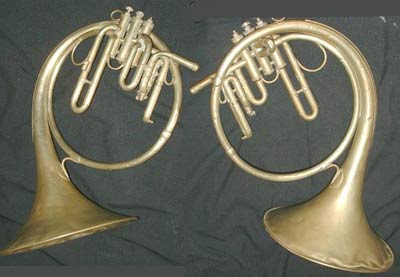 |
| Made by C. Mahillon, London
|
| 237 |
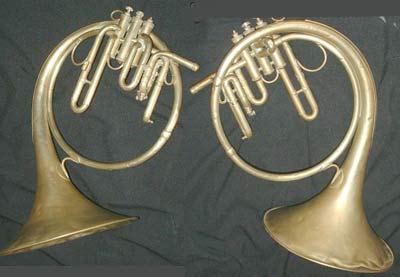
Tenor Cor |
Courtois |
|
1942 |
|
|
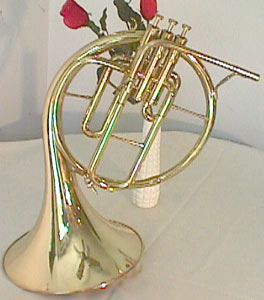 |
| This version of a mellophone instrument often being refered to as a Tenor Cor, this hybrid instrument employs the use of trumpet/cornet valves, cylindrical tubing, water keys, braces and lead-pipe.
The bell and bell tubing, however, were not fashioned on a Horn mandrel, as is typical with these instruments, but instead were thoughtfully redesigned so that the instrument as a whole was more integrated and unified in design, producing superior tone, intonation, resonance and response.
|