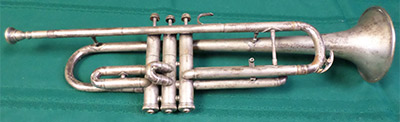
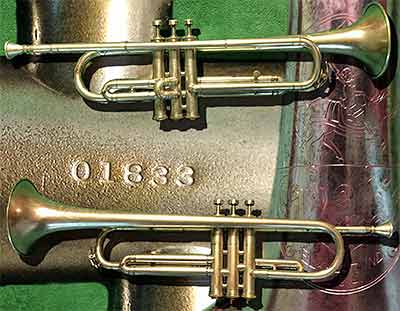
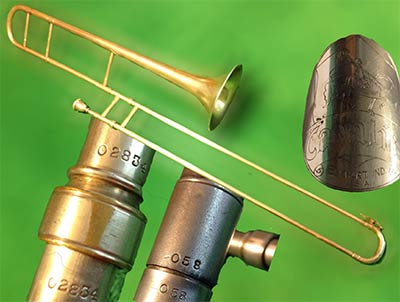
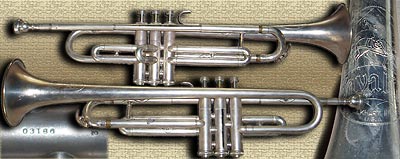
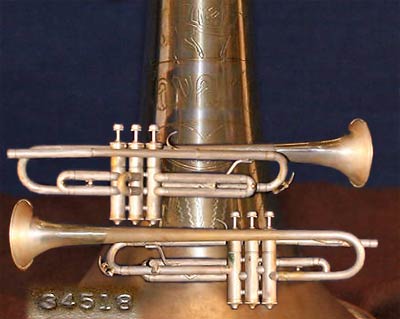
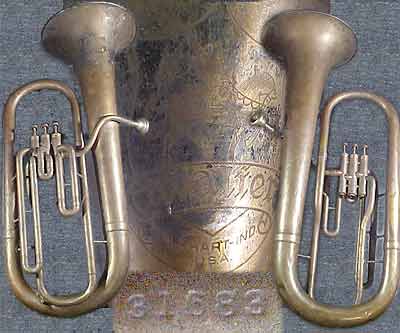
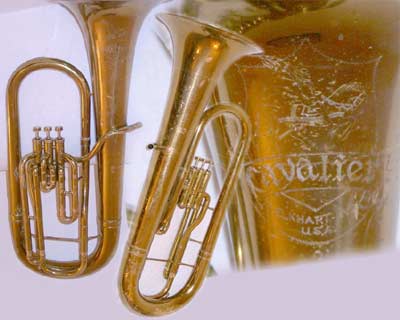
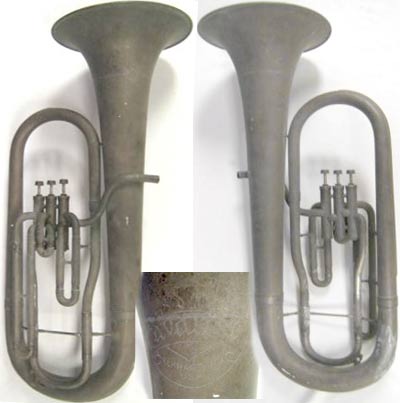
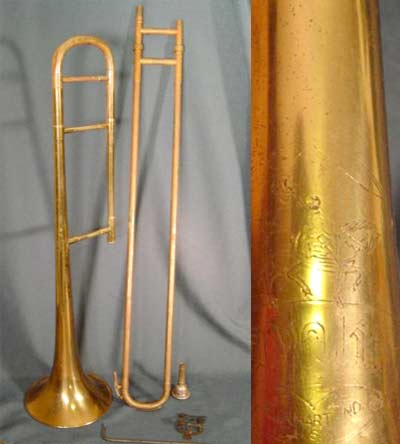
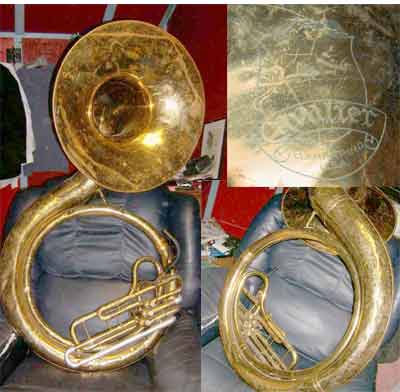
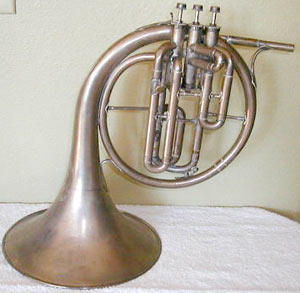
| Engraved:Cavalier- Elkhart, Indiana, USA.
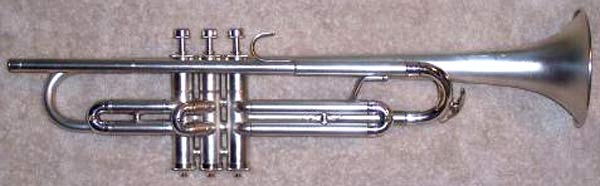
GSMonks: As you can tell by the angular sections that make up the bell, this was a cheaply made hybrid mellophone instrument that would probably be classed as a tenor cor, as it makes use of trumpet/cornet valves, braces, lead-pipe, water key(s) and cylindrical tubing.
This does not mean that this instrument would have performed poorly. Even when cutting corners, Conn was not known for sacrificing quality of sound or performance.
RE: the term "tenor cor":
A few years ago Niles Eldredge remarked to me in an e-mail (and keep in mind, at the time he also told me that this was pure speculation on his part) that the term "tenor cor" may have originated with someone like Hermann Koenig. When he asked Antoine Courtois to build his first Koenig horn, what he may have been after was some form of "tenor cornet".
The thing to remember here is that, despite the modern perception of these instruments, Hermann Koenig was a virtuoso cornettist, and his desire for a particular type of instrument to compliment this range is not a subject to be taken lightly. He most certainly would not have been the least bit interested in an amateurs toy.
Remember, too, that the "French" horn, or waldhorn as it is more properly called, though patented in valved version in 1818, still lingered on in "natural" valveless form, and was not quite the fascile instrument we think of today. In 1855-56, when the F Koenig horn came along, it seems logical that it would have been the choice of virtuosos of the day who typically "doubled in brass", as the saying goes, and whom likely would have prefered the Koenig horn as a second instrument to the waldhorn.
|