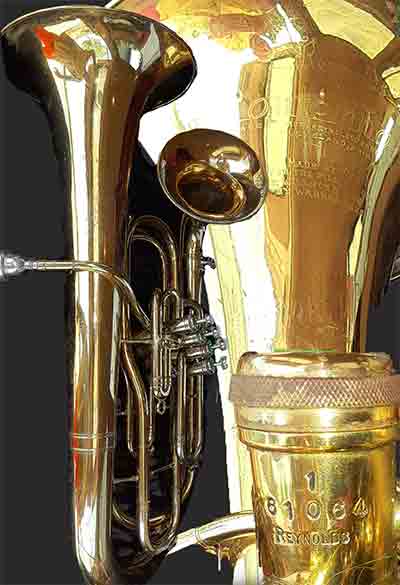
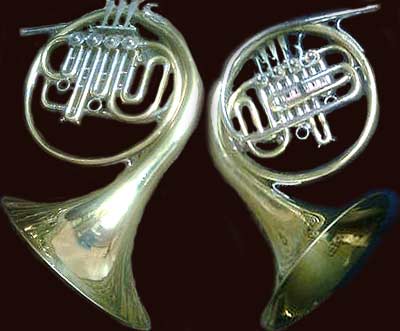
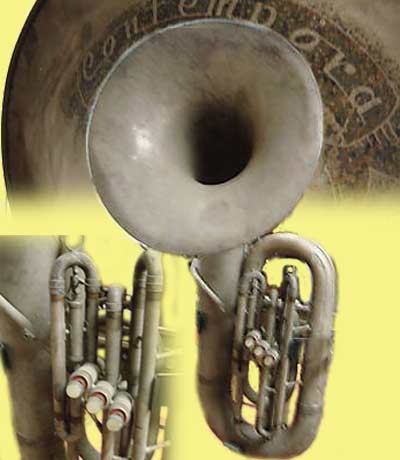
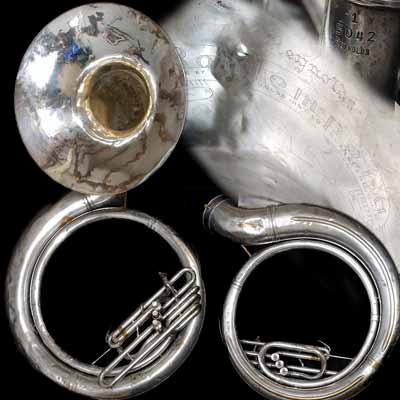
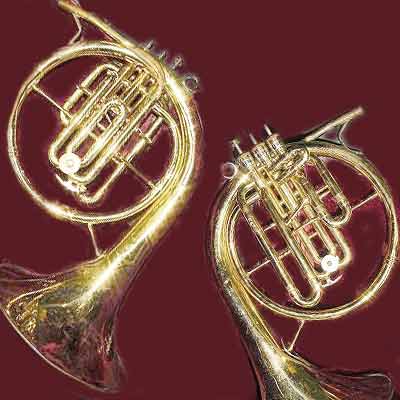
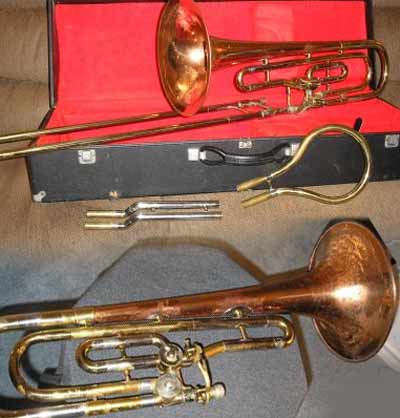
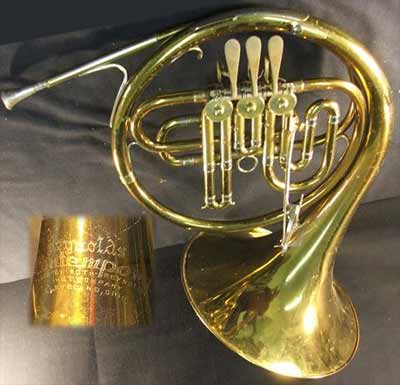
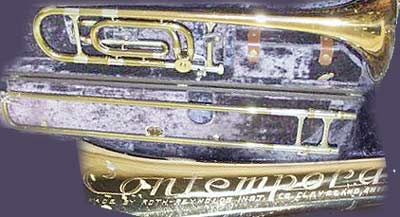
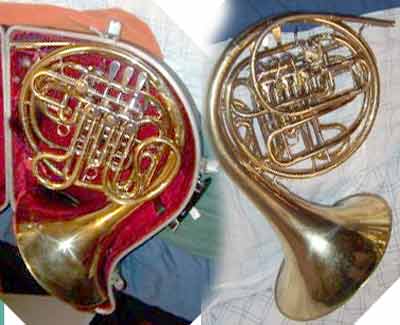
| horndawg: In an effort to boost horn sales in the early 1940s, Reynolds contacted Max Pottag, long-time second horn with the Chicago Symphony, to design and endorse a new horn. The design of the Reynolds Double French Horn, Pottag Model, was allegedly "borrowed" from Kruspe, but the dimensions and playing characteristics were very much like the Conn 6D, previously designed by Pottag. The "Contempora" brand name was added around 1950.
After Pottags retirement, Roth-Reynolds approached James Chambers (New York Philharmonic, 1946- 1969) with a similiar idea for collaboration. Chambers liked the existing layout of the Pottag horn, but wanted a bigger bell throat, heavier bell and the nickel-silver alloy that he was used to from playing his Conn 8D. After two years of design and development, he endorsed the Reynolds Contempora Double French Horn, Chambers Model in 1958 and played it for three seasons until a contract dispute with the new owners (Richards|RMC) regarding royalty payments and their expectations of his level of promotional activity for Reynolds prompted Chambers to return to his Conn 8D horn.
After James Chambers returned to Conn in the early 1960s, Reynolds removed the "Chambers" designation and kept the "Contempora" label. The Cleveland-produced Contempora FE-01 (nickel silver) and FE-03 (brass) horns retained the thicker bell of the Chambers model; however, when production moved from Cleveland to Abilene in 1964, the new horns had standard weight bells (.011" compared to .018"). Reportedly, there was also a change to the bell throat size, with the new horns placed somewhere between the Pottag and Chambers models. The horn specifications were tweaked again when Reynolds moved production to the Olds plant in Fullerton.
The Pottag, Chambers and Contempora Double French horns from Reynolds were very fine instruments in their day and highly rated along with well-known horns from Conn and Holton. To the ears of many, Reynolds Contempora horns play as well as the best custom horns being produced today.
The Contempora was a contemporary of the Conn 8D
The Reynolds Double French Horn is a most sensitively responding instrument and has an unusually easy-speaking upper register - so important to Horn players. Its wondrous tone quality, complete even range and sureness is noteworthy. I am using it exclusively, love it and I am happy indeed to recommend it to any French Horn player. [Max Pottag, 1953]
...
1940s-Early 1960s
Model 160
[FE-04]
Bb/F Double French Horn | Bore: .472" | Bell: 12"; medium bell throat | Large leadpipe | Kruspe wrap style | Materials: brass with nickel silver slide tubes and trim | Finish: clear lacquer finish
Model 161
[FE-02]
Bb/F Double French Horn | Bore: .472" | Bell: 12"; medium bell throat | Large leadpipe | Kruspe wrap style | Materials: solid nickel silver | Finish: clear lacquer finish | Introduced in mid 1950s
Model Notes
The Pottag Model 160 (brass) was available for almost 20 years, from the early/mid-1940s (SN 24264) to the early 1960s. Model 161 (nickel silver) was introduced late during the model lifecycle, most likely in conjunction with the nickel-silver Chambers horn developed in the late 1950s and introduced in 1958 (see below).
The Pottag models continued to be sold after the introduction of the Chambers model, even into the RMC-era of the company in the early 1960s, and were presumably discontinued along with the Chambers models after the new Contempora models were introduced (see above). Model renumbering, e.g. from 160 to FE-04, occurred during the Richards Music Company ownership (1961-1963).
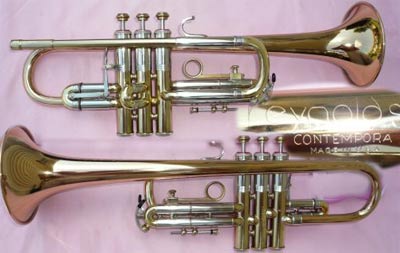
There was a report of an early model Pottag horn with a tone ring (kranz) similar to the Contempora trumpets, cornets and tenor trombones.
Howard Sanner on the Pottag Double Horn: "So how does it play? Very well, indeed! It is very free blowing, focused, good in all registers, with an especially easy top octave and a well-centered, easy-to-control low register. I recently played it and my Conn 8D at the inauguration of a recital hall some friends had built on their house. All present, me included, preferred the Reynolds to the 8D. It had a more focused, complex, warmer sound than the 8D."
Roth-Reynolds has spared no expense in the development and building of these superb instruments. Skilled designers and craftsmen have combined their arts and talents with James Chambers to make these the finest French Horns of all time ... the undisputed favorite of top French Horn players everywhere. Precision made rotary valves are of the quiet, floating type. They rotate on long, precision-fitted shafts and bearings. Preventing costly friction on the vital rotor shaft which otherwise causes malfunctions. As a result, the Reynolds French Horns are fast and easy to operate, and remain dependable over the years!" [1959]
Bb/F Double French Horn | Bore: .472" | Bell: 12" heavyweight bell (.018" thick); large bell throat | Large leadpipe | Kruspe wrap style | Materials: gold brass with nickel silver slide tubes and trim; metal cork holders and unplated rotor levers | Finish: clear lacquer finish
Model 191
[FE-01]
Bb/F Double French Horn | Bore: .472" | Bell: 12" heavyweight bell (.018" thick); large bell throat | Large leadpipe | Kruspe wrap style | Materials: solid nickel silver; metal cork holders and unplated rotor levers | Finish: clear lacquer finish
Model Notes
The Contempora Chambers horn was introduced in the fall of 1958. Chambers used and endorsed the horn for three seasons until Reynolds was purchased by Richards Music and a contract dispute with the new management team (see horn introduction above) led to the end of their collaboration.
James Chambers: "During the past two years I have collaborated with Roth-Reynolds skilled designers and French horn craftsmen in the development of a new and vastly improved Double French horn. The resulting instrument has exceeded all expectations. It combines maximum playing quality with an ease of response not generally associated with horns capable of producing such a full rich tone. Here, at last, is an instrument fully capable of satisfying the most exacting requirements of the professional while retaining those characteristics which make it the ideal choice for the student. Today I am using the Reynolds Chambers Model Double French Horn exclusively in my symphony, ensemble and solo playing, my recording work and teaching. I enthusiastically recommend this horn for all types of playing."
Bill Bamberg on the Chambers Double Horn: "As a horn player, I have several Contempora french horns. The Chambers model, when being built in Cleveland, I consider to be the best big American (Conn 8D clone) ever produced. When they went to Abilene, they discontinued the heavy bell, but an Abilene horn, properly set up, plays as well as the best custom horns being produced today. Recently I got a "new old stock" Cleveland Chambers to rest the Chambers I bought new in 1962. I did all my pro playing on that horn, and performed Mozart 3 with Fiedler and the Pops, in Symphony Hall, Boston, in 1969. My teacher, Ralph Pottle, played with the Boston Symphony. The Symphony players were impressed with the horn, but by 1969, the Cleveland horns were long gone. Jimmie Chambers played his for three seasons with the NY Philharmonic, until he had a falling out with the new Reynolds owners and went back to his 8D."
|