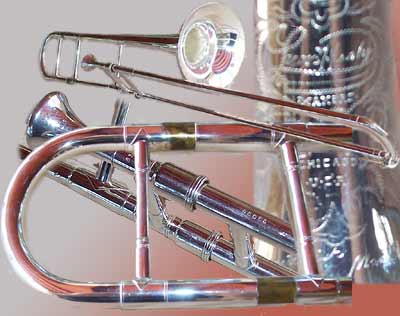
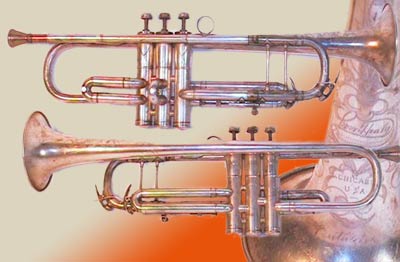
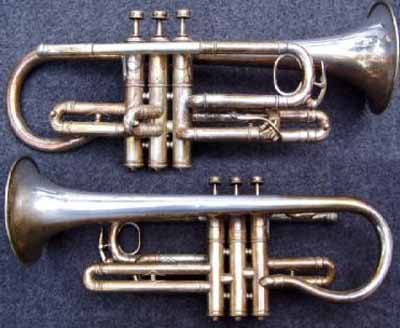
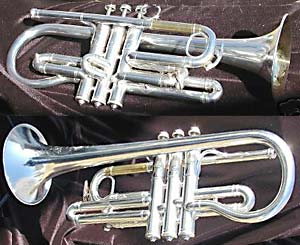
| Engraving: COUTURIER MODEL
NEW PROPORTION
MADE BY
FRANCK HOLTON
CHICAGO
Biber: It seems a little unclear to me as to what distinguished the Clarke model from the plain new proportion model and the couturier model. Was it just bore size? I have seen ads showing Clarke model instruments both with and without shepherds crook. Surely Clarkes customization of the model was more than bore size.
Pryorphone: The cornet stayed the same regardless of who was endorsing it (and whos name they put on it).
There were times when"New Proportion" model was made with was no endorsing artist: 1907 to some of 1909 and some of 1912 to at least 1918.
I know of "Couturier Model" New Proportions with 0, 0-, 0½, and 1 bores, so it would be my assumption that this worked the same way when Clarke endorsed them.
From 1918 on, the cornet was known as the "Holton-Clarke Model"
I have not tracked anything beyond Chicago, so I can not tell you any more than that.
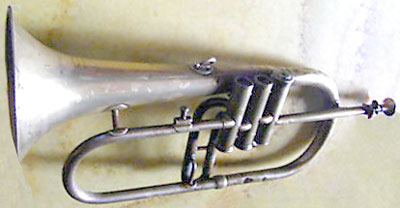
OLDLOU: I have two Holton Clarke Model cornets from about the same era. One is a shepherds crook type, which is appreciably shorter than the other, which is a typical extended cornet design. this just might answer the question per the Holton Clarke or Couturier, or, New Proportion short cornets. One of the major differences that I have noted in these two old horns is that the shepherds crook model will not fit into the original factory case for the non s c design. A minor difference is that the shepherds crook model will accept a modern Bach type cornet mouthpiece shank, whereas, the non s c horn has a much smaller diameter i.d. in the receiver.
Biber: as the New Proportion design or its other incarnations (Clarke, Couturier) ever offered as a trumpet or trumpet-shank instrument? the reason I ask is that I just saw a publicity photo of the fortmer child prodigy trumpet soloist Edna White. the photo was easily from the 1940s (eitherway considerably after her switch from cornet to trumpet) and showed her holding what I am almost 100% sure is a Holton-Clarke cornet.
Kenton: The Couturier line had a trumpet. Though it is really pushing it to call it a trumpet. i.e. a trumpet is supposed to be cylindrical until it goes into the bell branch. Course, no modern trumpets do fit this description. But the Couturier model took this to an extreme. It took a trumpet shank mouthpiece but was conical throughout.
I would be surprised if Clarke endorsed a trumpet. He was very vocal in opposition to the trumpet over the cornet.
|