Lignatone French Horns. Who was the actual maker? I know the Lignatone name was for export only. If I showed photos, could you identify the maker?
Thanks,
Books
General Topics
Inquiries Posts
The problem with Lignatone is that it is probably best described as a shared brand name. A case could also be made that it is much like a store brand of a dealer. Various makers contributed product to the brand name Cerveny, Bohland and Fuchs, Ligna, Lidl, and Amati all seemed to have played a role.
Indeed, Lignatone was a brand name used by Communist (Czech) state-run companies from Graslitz/Kraslice, combined together in the Amati co-op. This was originally started as a privately owned company by Keilwerth, Kohler and Huller after WW2, but when the Communist Party took over in 1947, it was nationalized until 1990. During this period, other companies as mentioned by Kenton likely were added to the co-op.
I recently got donated a Baritone Horn for my program. I am not very knowledgeable in brass but I am basic. On the 2nd valve casing it has the number 843331. The Horn itself has 3 valves front-facing, the bell comes off with screws. The brand engraving on the top says C. G. Conn Indiana with a lady below it. It has 1 small slide at the top on the 2nd valve (maybe there is another but nothing I pull comes out) and 2 spit valves. It is silver color on the outside with gold on the inside. Any ideas on a model/make? Is it even a baritone (maybe its a euphonium?)? All thoughts greatly appreciated! :)
Looking at the Conn production line for Baritones/Euphoniums, with a serial# placing it in 1960, 3 font valves and removable bell, there are a few options:
- if bell slanted forward, it is probably a Wonderphone/Artist 20I, but there is a slight possibility of it being a very early Artist 10I.
- if bell up, it is an Artist 21I
- if bell slanted forward, it is probably a Wonderphone/Artist 20I, but there is a slight possibility of it being a very early Artist 10I.
- if bell up, it is an Artist 21I
Ready for the Database? Since Jupiter is on there, perhaps some of their earlier work can be posted...
I recently found some Swallow brand trumpets on eBay and other sites, including several marked Swallow Formosa [rather than Taiwan], appearing on the Japanese market, which might explain the phrasing.
Several of these Japanese-market horns had their original sales tags from Zen-On [the Japanese music store], giving us a model number where some were uncertain.
Swallow, of course, was the first brand KHS used for its brass instruments; the first KHS factory started in Luzhou, Taipei, 1956 making harmonicas under the Swallow and Butterfly brands. Swallow trumpets and trombones followed in 1957.
Notably, the bell engraving pattern often seen is identical to Nikkan Imperiale models, and the single-point-guide "Courtois-style" pistons are similar to Nikkan ones.
Yamaha and KHS did cooperate at a few times, so this may be intentional. See the pistons at https://www.ebay.com/itm/389410655686
https://khsen.so-buy.com/front/bin/ptdetail.phtml?Part=Organization-03 / https://www.katamusic.hk/en/2024/02/tw-yamaha-2/ / https://www.saxontheweb.net/threads/eugene-rousseau-the-development-history-of-yamaha-saxophones.348622/
A bit messy, but given how various instrument makers cooperated at times, not suprising.
The Swallow 65L is the Connstellation imitation seen under brands ranging from DEG "Caravelle 500" to Roland Meinl "The New Constellation" [sic] Meinl Super De Luxe.
https://drive.google.com/drive/folders/1kEoEHXn5YTZmcxr2P-I3U4xLn7bsXHEe has the Zen-On tag and serial 703189 visible
https://drive.google.com/drive/folders/1GnpNPtvODKfFenUjBHYJgN3r4OAYsrY_ 703271 is another example
https://drive.google.com/drive/folders/1zlXirGhYlTS55yzcaC3VYIjnwyuEvzCM is yet another, but the serial isn't legible [and was only 215x from an old auction description]
The year for these isn't clear, but 1970s based on the sales-receipts of other KHS stencils found. It could be 1970, if the below claim is correct...
The Swallow STR40 uses a Jupiter-esque model number, and is similar to the later STR-300 and STR-600 or Centurion [particularly the Benge-style lower tuning slide leg]. If STR-400 ever existed, this could be it.
https://drive.google.com/drive/folders/1to8uZG4GR0SXZhg02Lgr-2F4h6Kx0SMF serial might start with a 6 [on the card], ending in 82 [per stamp] "Swallow Formosa"
https://drive.google.com/drive/folders/18FI6LNFCCEjq_tjFG09So-GyFM0fRi6B 680461 "Swallow Formosa"
https://drive.google.com/drive/folders/1VFJGDod9EzwzfQ9aptzQOHKGyO-Htd5Q 692852 "Swallow Formosa"
https://reverb.com/item/6956607-swallow-50ln 722431, with the blackletter logo like some early Jupiters, and model number following this convention: https://www.usedprice.com/items/guitars-musical-instruments/galaxia/trumpet/
Galaxia was another KHS stencil client
Additionally, https:// paypayfleamarket .yahoo. co. jp/item/h1173804304 [spaces added to prevent hotlinking of this one] makes an interesting claim I can't quite verify.
Apparently the first two digits of 6-digit KHS serials prior to 1986 indicate the Gregorian calendar year. I have seen various KHS stencils with 4-digit serials [mostly the Connstellation types, like a DEG Caravelle, Omega, and Swallow 65L serial 215x], otherwise identical to 6-digit versions, and this doesn't contradict the few with original sales receipts.
The lowest 6-digit, consistent-sequence serial KHS horns I've found were 59xxxx. There are some outliers, and plenty of uncertain 5-digit examples, but the 6-digit sequence lines up with the Conn copies KHS was cranking out by the 1960s, and the earliest Connquest 77B clones start at 61xxxx so far. This might not mean anything, but it's a curious trend.
I haven't collected any wide-font, pre-1986 serials higher than 85xxxx, for what it's worth, and the 1986 serials start at 500000 with narrower numbers than prior [the same stamp font used to present day]. 500k is 1986, 600k is 1987, etc. 900k is 1990, 000k is 1991, 100k 1992, etc. and the JPT model prefix starts in 1990.
The only issue is I have Jupiter-branded instruments with 68xxxx serials, and supposedly that brand didn't appear until the later 1970s. That could mean old valve blocks were being used [seeing UMI serials jump around with some higher numbers bearing a 41 prefix, then lower ones with 42, plus testimony from UMI employees supports that]...or perhaps the Yahoo listing claim is nonsense!
I recently found some Swallow brand trumpets on eBay and other sites, including several marked Swallow Formosa [rather than Taiwan], appearing on the Japanese market, which might explain the phrasing.
Several of these Japanese-market horns had their original sales tags from Zen-On [the Japanese music store], giving us a model number where some were uncertain.
Swallow, of course, was the first brand KHS used for its brass instruments; the first KHS factory started in Luzhou, Taipei, 1956 making harmonicas under the Swallow and Butterfly brands. Swallow trumpets and trombones followed in 1957.
Notably, the bell engraving pattern often seen is identical to Nikkan Imperiale models, and the single-point-guide "Courtois-style" pistons are similar to Nikkan ones.
Yamaha and KHS did cooperate at a few times, so this may be intentional. See the pistons at https://www.ebay.com/itm/389410655686
https://khsen.so-buy.com/front/bin/ptdetail.phtml?Part=Organization-03 / https://www.katamusic.hk/en/2024/02/tw-yamaha-2/ / https://www.saxontheweb.net/threads/eugene-rousseau-the-development-history-of-yamaha-saxophones.348622/
A bit messy, but given how various instrument makers cooperated at times, not suprising.
The Swallow 65L is the Connstellation imitation seen under brands ranging from DEG "Caravelle 500" to Roland Meinl "The New Constellation" [sic] Meinl Super De Luxe.
https://drive.google.com/drive/folders/1kEoEHXn5YTZmcxr2P-I3U4xLn7bsXHEe has the Zen-On tag and serial 703189 visible
https://drive.google.com/drive/folders/1GnpNPtvODKfFenUjBHYJgN3r4OAYsrY_ 703271 is another example
https://drive.google.com/drive/folders/1zlXirGhYlTS55yzcaC3VYIjnwyuEvzCM is yet another, but the serial isn't legible [and was only 215x from an old auction description]
The year for these isn't clear, but 1970s based on the sales-receipts of other KHS stencils found. It could be 1970, if the below claim is correct...
The Swallow STR40 uses a Jupiter-esque model number, and is similar to the later STR-300 and STR-600 or Centurion [particularly the Benge-style lower tuning slide leg]. If STR-400 ever existed, this could be it.
https://drive.google.com/drive/folders/1to8uZG4GR0SXZhg02Lgr-2F4h6Kx0SMF serial might start with a 6 [on the card], ending in 82 [per stamp] "Swallow Formosa"
https://drive.google.com/drive/folders/18FI6LNFCCEjq_tjFG09So-GyFM0fRi6B 680461 "Swallow Formosa"
https://drive.google.com/drive/folders/1VFJGDod9EzwzfQ9aptzQOHKGyO-Htd5Q 692852 "Swallow Formosa"
https://reverb.com/item/6956607-swallow-50ln 722431, with the blackletter logo like some early Jupiters, and model number following this convention: https://www.usedprice.com/items/guitars-musical-instruments/galaxia/trumpet/
Galaxia was another KHS stencil client
Additionally, https:// paypayfleamarket .yahoo. co. jp/item/h1173804304 [spaces added to prevent hotlinking of this one] makes an interesting claim I can't quite verify.
Apparently the first two digits of 6-digit KHS serials prior to 1986 indicate the Gregorian calendar year. I have seen various KHS stencils with 4-digit serials [mostly the Connstellation types, like a DEG Caravelle, Omega, and Swallow 65L serial 215x], otherwise identical to 6-digit versions, and this doesn't contradict the few with original sales receipts.
The lowest 6-digit, consistent-sequence serial KHS horns I've found were 59xxxx. There are some outliers, and plenty of uncertain 5-digit examples, but the 6-digit sequence lines up with the Conn copies KHS was cranking out by the 1960s, and the earliest Connquest 77B clones start at 61xxxx so far. This might not mean anything, but it's a curious trend.
I haven't collected any wide-font, pre-1986 serials higher than 85xxxx, for what it's worth, and the 1986 serials start at 500000 with narrower numbers than prior [the same stamp font used to present day]. 500k is 1986, 600k is 1987, etc. 900k is 1990, 000k is 1991, 100k 1992, etc. and the JPT model prefix starts in 1990.
The only issue is I have Jupiter-branded instruments with 68xxxx serials, and supposedly that brand didn't appear until the later 1970s. That could mean old valve blocks were being used [seeing UMI serials jump around with some higher numbers bearing a 41 prefix, then lower ones with 42, plus testimony from UMI employees supports that]...or perhaps the Yahoo listing claim is nonsense!
Hi, I would like some information on a trumpet I have. I a pretty sure it is a York, but only information engraved on the bell is Airflow, It seems similiar, but different than the model 75. Serial number on it is 206549.
thank you
Charles
thank you
Charles
Charles,
If the horn is the one I'm thinking of (based on serial number) it is difficult to determine it's pedigree. The reason is unlear why it doesn't state "York" as the manufacturer, but it is NOT one of the famous York Air-Flow trumpets or cornets. Those were very distinctive and looked like this:
The York Band Instrument company was sold to Carl Fischer Musical Instruments in 1940. The patent for that design was not included in the sale by the owner. Years later someone used the name only for a completely ordinary cornet. My guess is that Fisher owned the name but not the design, and had one of the several companies it owned or had relationships with build it. It could have been York, Blessing, B&M, or someone else. If it was York, and they used their serial numbers it would put the date about 1957.
Lack of documentation has kept me from going any further on this.
Regards,
Mike Keller
If the horn is the one I'm thinking of (based on serial number) it is difficult to determine it's pedigree. The reason is unlear why it doesn't state "York" as the manufacturer, but it is NOT one of the famous York Air-Flow trumpets or cornets. Those were very distinctive and looked like this:
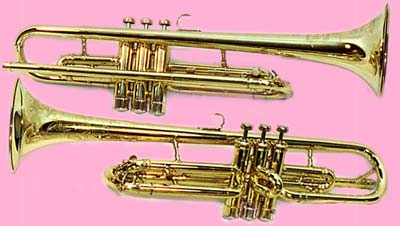
The York Band Instrument company was sold to Carl Fischer Musical Instruments in 1940. The patent for that design was not included in the sale by the owner. Years later someone used the name only for a completely ordinary cornet. My guess is that Fisher owned the name but not the design, and had one of the several companies it owned or had relationships with build it. It could have been York, Blessing, B&M, or someone else. If it was York, and they used their serial numbers it would put the date about 1957.
Lack of documentation has kept me from going any further on this.
Regards,
Mike Keller
I'm looking at a trombone online and it has "The New Yorker" engraved on the bell. I've run that back to affiliations with B & J (Buegeleisen & Jacobson, NYC), but I cannot find any further info on them making or importing "The New Yorker" Tenor Trombone. Maybe made in Europe? Anyone have any links that may shed light?
I have come into possession of a Hawkes & Son G-bass trombone. The engraving on the bell says Territorial Superior Class Hawkes & Son Denman Street Piccadilly Circus London G LOS R. F. A. This means the horn was built between 1895-1925 according to the Howell and Myers chapter on the company. To better refine the date I have tried to find the serial number on the horn and haven't been able to locate it. Any advice on where to look?
On Hawkes & Son cornets, the serial number is often found near the bell rim. (for example https://www.retiredbrass.com/portfolio-collections/cornets/hawkes-son-1900 and https://www.retiredbrass.com/portfolio-collections/cornets/hawkes-son-1895)
Maybe it is the same with trombones?
Maybe it is the same with trombones?
I have an F. Besson cornet from 1886. Is there a local shop in Phoenix. AZ that can restore and appraise?
Appreciate the assist!
I do not know any repair techs in the US, but I am interested in antique Besson instruments/cornets. I have one from 1875 and one from approx. 1880 and a Saxhorn from approx. 1885. I am very interested to know the exact text of the inscription on the bell (including the medal count) as well as the exact description of the company stamp (spelling Brevetée/Breveté; crown or star) and the serial number on the 2nd valve casing. Pictures would be ideal.