A Rose by any other name
Saxhorns and Saxtrombas
Feb 16th, 2021,
I was recently reading an article that claimed that the saxhorn band as we know it is really a misnomer. Specifically, it stated that two members of the saxhorn family were really saxtrombas; namely the alto horn and the tenor horn.
I recently had a very interesting discussion about these and related instruments with Robb Stewart, and on one hand you have a few underlying principles, and on the other you have hair-splitters with no real case to make.
Take bartones and euphoniums, for example. Neither exist. Both are tenor tubas (or flugelhorns), which come in various bore, shapes, sizes, but nevertheless remain what they are- tubby the tubas.
Saxhorns (Saxtrombas) are modified flugelhorns, as are tubas. The taxonomic line goes: cornetto, serpent, ophicleide, valved ophicleide (the Moritz/Weiprecht 1st tuba), various tenor and bass valved bugles in the 1830s and 1840s, the Saxhorns in the 1840's that were a reaction to existing instruments, the tubaform tubas of Cerveny in the 1850's (later copied by York), and Austrian flugelhorns made by Schneider (not the wiener guy).
If you look at catalogues of the early Sax horns, you'll see why Sax was unable to secure the patent for them. They're just a family of flugelhorns. The form they take today was created by Courtois, who modified Sax's family of flugelhorns by making the bell more cornet-like.
kenton
Reply #2 - Sep 12th, 2021,
Ah, well, you can make the categories with varying degrees of tolerance. However, if you look at just the tenor horns, baritones, and Bb basses in a saxhorn/silver cornet band; they have very different roles and sounds. Similarly, you could lump cornets, trumpets and fluglehorns.
Reply #3 - Sep 13th, 2021,
The modern "trumpet" is a cornet and should be lumped with the cornets. If you recall, it appeared ca 1910 made by Conn and Lyon & Healy, marketed as a "long-model cornet" if it came with a cornet mouthpiece, and "trumpet" if it came with a trumpet mouthpiece. Conn did this the same year with their so-called "slide cornet" and "slide trumpet".
Did we ever find out if the Lyon & Healy horns were stencils? It seems impossible that they'd come out the same year with the same instrument.
_______________________________________________
Tenor/baritone voices
Feb 8th, 2006,
The ad for a King 1130 Marching Trombone created some discussion of what this horn should be called.
So are terms like:
marching trombone
marching baritone
marching euphonium
flugabone
valve trombone
bass trumpet
bass cornet
bass flugelhorn
just marketing ploys or are there some valid distinctions to be made? The valve trombone has a different wrap, but otherwise all the above have basic a 'trumpet' look to them.
So, the King dimensions given were:
King's Marching Trombone (1130) has a 8-1/2in bell; .500 bore
King's marching baritones (1124 and 1127) have a .500 bore but with a conical bore, large throated bell, and lead pipe design.
King's marching euphonium (1129) has a .562 bore, but it has an 11-inch bell and a large shank mouthpiece receiver.
Can we make a distinction on just dimensions? If so, then if one is given some dimensions, then one wouldn't need to see the horn to know what it is.
Obviously, this is or will likely spill over into the differences between concert bell-up shaped tenor horns, baritones, and euphoniums.
Now, I have around the house horns with these dimensions.
.485 bore - 9 1/4 in bell
.560 bore - 10 in bell
.560 bore - 11 1/4 in bell
.592 bore - 10 3/4 in bell
Can you tell me what they are?
Is the difference between names based on their measurements, what they look like, or how they sound? Or none of the above?
I would simply submit that:
marching trombone, marching baritone, marching euphonium, flugabone, valve trombone, bass trumpet, bass cornet, bass flugelhorn, tenor horn, baritone, euphonium, tenor saxhorn, baritone, saxhorn, Bb bass saxhorn
is too long a list. Surely, some of them are the same thing. But which ones?
Reply #1 - Feb 8th, 2006,
I will submit that "marching" is just a modifier, not a model, and means 'compact 3 valve bell front'.
Saxhorn to me implies bell- up.
trumpet/trombone
cornet/baritone
flugelhorn/euphonium/tuba
imply to me the same general bore shape.
Reply #2 - Feb 8th, 2006,
It's just a valve trombone that has been reconfigured for marching. It ain't a flugle anything, nor is it a saxhorn or tuba/euphonium anything. It has cylindrical, not conical tubing.
Trombones are cylindrical. Saxhorns are a mixture of cylindrical and conical. Flugles are conical. Euphoniums are a different mixture of conical and cylindrical from Saxhorns.
Marching baritones and euphoniums are just rewrapped baritones and euphoniums.
All these horns sound just like their analogues. The sound is a result of the bore-profile, not the shape or configuration. Wrapping them up, adding bends, can lead to stuffiness if it's not done well, but that doesn't constitute a difference, but rather a design quirk.
Reply #3 - Feb 8th, 2006,
quote
Trombones are cylindrical. Saxhorns are a mixture of cylindrical and conical. Flugles are conical. Euphoniums are a different mixture of conical and cylindrical from Saxhorns.
Then the marching trombone is the same as the bass trumpet, then, right?
Quote:
Marching baritones and euphoniums are just rewrapped baritones and euphoniums.
Which would make them the equivalent of a bass cornet, then right?
All these horns sound just like their analogues. The sound is a result of the bore-profile, not the shape or configuration. Wrapping them up, adding bends, can lead to stuffiness if it's not done well, but that doesn't constitute a difference, but rather a design quirk.
I tend to agree with that. So, if we can decide which in the above list are just "twisted funny" then we can start merging!
Reply #4 - Feb 8th, 2006,
So far, I would place the Baritone as a Bass Cornet
The Euphonium as a Bass Flugle
and the Valve trombones as a Bb bass trumpet.
I think the Tenor horns (Bb) would also be in the Bb bass trumpet category.
I do not believe that the bore is indicative of the type. Unless you are looking at one year of one maker.
Reply #5 - Feb 8th, 2006,
quote: Then the marching trombone is the same as the bass trumpet, then right?
No, the bass trumpet is a different instrument altogether. Some poorly designed bass trumpets ARE just valve trombones, but a proper bass trumpet is a bass trumpet, and SOUNDS like a bass trumpet. They're used in Wagner in the Ring cycle. Borrow a recording and have a listen. You can really hear the difference between a valve trombone and a bass trumpet.
quote:Which would make them the equivalent of a bass cornet, then right?
No, a bass cornet (an extremely rare and extinct instrument) is a bass cornet. Neither the baritone nor the euphonium is related to the cornet. The baritone is a Saxhorn, the euphonium is a tenor tuba. Some resource books claim that the saxhorns are members of the cornet family, but that claim is erroneous. The Saxhorns are valved bugles, a taxonomic off-shoot one family removed from the keyed bugle. The Saxhorns are indirect relatives of the flugle family. The cornet is a taxonomic off-shoot of the furst pless horn.
quote: All of these horns sound just like their analogues. The sound is a result of the bore-profile, not the shape or configuration. Wrapping them up, adding bends, can lead to stuffiness if it's not done well, but that doesn't constitute a difference, but rather a design quirk.
The only instrument whose name is misleading is the flugabone. The flugabone is just a compact valve trombone. Look at the tubing- it's cylindrical, except for the bell.
There's no such thing as a "bass cornet" anymore. They're long extinct. Conn used to make an Eb alto cornet. Here's what they looked like (the bass was just a bigger version of this horn):
http://www.xs4all.nl/~cderksen/Conn10Cdraw1924image.html
Here are some photos of bass and contrabass trumpets:
http://www.contrabass.com/pages/cbtp.html
Reply #7 - Apr 16th, 2006
Quote:
No, the bass trumpet is a different instrument altogether. Some poorly designed bass trumpets ARE just valve trombones, but a proper bass trumpet is a bass trumpet, and SOUNDS like a bass trumpet. They're used in Wagner in the Ring cycle. Borrow a recording and have a listen. You can really hear the difference between a valve trombone and a bass trumpet.
Umm, isn't the Wagner - The Ring part supposed to be played by a Wagner Tuben?
Reply #9 - Apr 16th, 2006,
When it says "The sound of a bass trumpet can be difficult to distinguish from a valve trombone" I take that to mean that 98% of the listeners won't know the difference.
The other 2% will know what the horn is and "believe" they hear a difference.
Reply #8 - Apr 16th, 2006,
The Ring uses both Wagner tubas and bass trumpets. Both are used for different purposes in the Ring cycle. The low trumpets play the heroic motifs, and the Wagner tubas play the high-volume Horn (upper-middle brass) parts.
In Wagner's music, the Wagner tubas are used in fours- two F's and two Bb's- and are played by four of the Horn players.
There is a lot of misconception and misunderstanding about what Wagner tubas are and what their purpose is. At low volume they are pretty much indistinguishable from the Horn- not surprising, because they're a double-length brass wind and are a member of the same family.
The difference is what happens at high volume. The Wagner tubas kick butt in that middle range, and have that characteristic wild, hysterical sound, that gives the music a bit of a manic dimension that is very effective.
Reply #11 - Apr 17th, 2006,
When it says "The sound of a bass trumpet can be difficult to distinguish from a valve trombone" I take that to mean that 98% of the listeners won't know the difference.
The other 2% will know what the horn is and "believe" they hear a difference. [/quote]
A real bass trumpet is easy to distinguish from a valve trombone. The two horns sound nothing alike.
Bass trumpets generally fall into two categories- junk that sounds like a valve trombone, and what some guys call a "tenor" trumpet to distinguish it from the horns with a larger bell and bore.
The designations "tenor" and "bass" do refer to two distinct classes of horns which can be confusing, as "bass" refers to both versions, and "tenor" refers to horns that never sound like valve trombones.
These are very different horns that sound nothing alike. The Lidl sounds like a trumpet- there is no mistaking its sound. It has a much smaller bore and a trumpet size and type of bell and is played with a bass trumpet mouthpiece. I use a Schilke 40B bass trumpet mouthpiece which is 22.51 mm cup diameter and very shallow. The DEG, however, takes a standard trombone mouthpiece, has a trombone-size bell, and has a trombone-size bore.
Reply #13 - Apr 17th, 2006,
Kewl - I knew about the "pairing" of the Wagner Tuben, but I didn't know about the bass trumpet being snuck in there (showing my lack of having played The Rings). I want a Wagner Tuba now more than ever - I lo-ove to play music that encourages the tubas to kick butt (probably shows because I will really enjoy playing my York - when I get the valve body repaired / replaced) ....
Reply #14 - Apr 17th, 2006,
I hope you know that Wagner tubas are not tubas . . .
Wagner tubas are members of the Horn family. They come in F, Bb, and there are new ones now available in F/Bb. They are traditionally played by Horn players, and like the Horn are left-handed.
Wagner tubas are just rewound Horns with an upright bell that ends in a rimless funnel. At low volume, you can't tell Wagner tubas from Horns. Gets your hands on some horn octet recordings where the guys switch to Wagner tubas for some pieces, and you see (hear) what I mean.
To play the Wagner tuba means being able to handle a Horn mouthpiece, because that is the mouthpiece used in them.
The characteristic design of the Wagner tuba (the bent bell) was taken from the Cerveny lower brass winds (also known as Baltic brass). I suspect the name "tuba" may have been a transposition from the Cerveny horns, which are tubas.
pryorphone
Reply #16 - Apr 17th, 2006,
In use, though, wasn't this just for diehards who wouldn't give up on the solo alto idea (which I gather wasn't THAT well-used a concept as it was)?
Reply #17 - Apr 17th, 2006,
quote: The flugabone is just a marching valve trombone. A marching trombone is just a short-model valve trombone. Marching brass are just bell-forward versions of their bell-up analogues. Modern bass fluglehorns are actually just marching Eb tenor (alto) horns or marching baritones, both of which are saxhorns. Real bass fluglehorns are another instrument altogether. The bass trumpet is a bass trumpet. The valve trombone is a valve trombone. The Bb bass saxhorn is a Bb bass saxhorn and is not to be confused with a Bb tuba. The large and small-bore baritones are both Bb tenor saxhorns. Saxhorns are a family of instruments, from the Bb piccolo to the EEEb contrabass.
Very well said,
So, we have Marching model horns marketed for marching and we have others hopefully better sounding marketed for solo and ens. work.
I think it is important to note that the marching world is a culture all its own and the terminology differs. Just as if we were talking about Alto/Tenor Horns.
The big difference I see between the bass Tpt and others is the mouthpiece used.
Reply #18 - Apr 17th, 2006,
The bass trumpet is its own animal. It sounds like a trumpet, not anything like a trombone. When you hear a good bass trumpet, what you hear is "trumpet".
If I were to play a Bb, an alto, and a bass trumpet, side by side, you'd hear right away that they sound like one and the same thing.
Another reason guys call the bass trumpet a tenor trumpet is to differentiate it from the contrabass trumpet, which, instead of being in low Bb, is usually in low Eb.
A good bass/tenor trumpet can have up to five valves, and an extremely large range. The mouthpiece facilitates this, in part, and some of the repertoire is demanding in the extreme.
Regarding the mouthpiece- if you play a bass trumpet with a trombone or baritone mouthpiece, it still sounds like a bass trumpet. It just gets muddy if you use a bigger, deeper cup.
Reply #19 - Apr 17th, 2006,
http://www.xs4all.nl/~cderksen/Conn10Cdraw1924image.html
In use, though, wasn't this just for diehards who wouldn't give up on the solo alto idea (which I gather wasn't THAT well-used a concept as it was)?
What this horn represented was yet another attempt to produce more of one type of instrument. For some reason, the upper-middle brass range saw far more of these attempts than any other register.
What edged these experiments out was the pervasiveness of the "French" horn, which pushed everything else aside, including the alto trombone, alto trumpet, alto cornet, Eb tenor (alto) saxhorn, mellophone, Frumpet, and a host of 19th century horns like cornophones, ventil horns, antoniophones, altophones, and so on.
The unfortunate thing is that some of these were very good instruments that were a lot of fun to play. The alto cornet plays like a greased weasel and is a great horn if you can find someone used to the mouthpiece type- which unfortunately is a rarity.
Reply #20 - Apr 19th, 2006,
Not being a 'Lowbrass' player, I have always had a problem defining the differences between tenor horns, baritone horns, euphoniums, and the small tubas. As a trumpeter/cornetist the differences between the various forms of trumpets, cornets and flugels, (don’t get me started on "Saxhorns" ) has always been 'fairly definite in my mind and in the conversations with low and middle brass players. I personally think that much to-do about little has occurred in this field. In England an alto horn is usually called a tenor and a baritone a euphonium. What gets me is the common term of "trumpet" for all of them by many players and conductors over there.
At York, we called a side valve, bell front middle brass instrument a baritone horn. An upright, Raincatcher version of the same was a euphonium. Likewise, a raincatcher Eb alto was called a tenor horn, (misnomer in my opinion). A bell-front, side valve instrument in Eb was an alto horn. All the last three were generically known as "peck horns" to the workers there. Valve trombones were a popular item being shipped with both a slide section, and a valve section, both using the same bell section and mouthpiece.
Then came the so-called marching versions of the above and a new can of worms was opened. They all looked somewhat like a trumpet or cornet and were held and played like a trumpet or cornet. The "marching' name that was added to these horns was in my opinion the worst misnomer I had ever heard. I 'tried' to play a marching baritone in a parade, while marching. As a big, strong young man I had a nightmare trying to balance that blasted thing and to play it properly while trying to hold it up and keep a proper embouchure. It was front heavy to the extreme. After one of Sousa's marches and one city block of marching I was wishing that I was still playing my grandpa's short British cornet. Perhaps the Brits do have 'some' sense after all. By the end of that ONE parade that I was in with such a plumber’s nightmare I thought that both of my arms were going to fall off and I vowed to NEVER do such a foolish thing again. I even envied the Sousaphone players. At least their horns were somewhat balanced on their shoulders.
Reply #21 - Apr 19th, 2006,
And then we have Tubas.
BBb CC EEb and Eb and F and 2/4 3/4 4/4 5/4 6/4 and "Monster"
But they are all Tubas. Even if they have more than 4 valves.
Reply #22 - Apr 19th, 2006,
I hate to continue tubas on the tenor thread, but sousas are also tubas - except by name.
Reply #23 - Apr 19th, 2006
As are helicons (Eb alto, Bb tenor, F, Eb base, CC, BBb contrabass).
Helicons and sousas are the original "marching" instruments.
Reply #24 - Apr 20th, 2006
Don't hate me, but . . .
While all these brass winds are basses, they are not all tubas. Helicons and Sousas belong to the same taxonomic class, whilst other basses include tubas, saxhorns, Cerveny brass which are a taxonomic subclass of tuba, and a daunting variety of basses that fall between.
Basses with skinny bells and no lead-pipe are saxhorns. Basses with a very wide, conical bell are true tubas. And so on.
The same confusion surrounds Bb tenor upright brass winds such as small- and large-bore baritones which are Saxhorns, euphoniums which are tenor tubas and are sometimes called "baritone horns", and a wide assortment of in-between horns that defy exact categorization.
Reply #25 - Apr 20th, 2006,
You're far from alone, but it is possible to sort all these horns out.
The first thing to do is look at the bore-profile, not the configuration (bell-up, bell-forward, "marching", etc.), and make your determination from there.
The large- and small-bore baritones are Saxhorns. The euphonium is a tenor tuba.
What serves to confuse the issue is all the in-between instruments, most of them cheap band instruments, that are of no one design. Plus, there are a few unique US- and British-made horns that are between Saxhorns and euphoniums.
This is not to disparage these instruments- some of them are very good players, whatever you choose to call them.
For all of these "other" horns, I suggest an extra category in which to place them all- "miscellaneous". Same goes for basses that are neither tubas nor Saxhorns nor Cerveny brass winds, nor Helicons nor Sousas.
Reply #27 - Apr 20th, 2006,
So, looking at lead pipes, this a saxhorn,
As far as Tubas and sousaphones, to me they seem to be the same horn, wrapped differently.
Reply #29 - Apr 20th, 2006,
"I don't know how to describe it.
But I will know it when I see it."
There is the Art of design and the Engineering of design. I think for us we should decide on first a bore profile and then break it down by bore size.
I have a nice little "Euphonium" with a small bore and a smaller than tenor shank MP. This horn sounds and plays more like my Yamaha than my old Besson Euphoniums, but with a small bore.
In contrast, I have also played the newer Yamaha marching "Baritones" or whatever they are called. and these things have a larger bore, but they have the mostly cylindrical profile. These things sound and play more like a true "Baritone".
It seems to me that the common profile breakdown seems to be:
Tenor: bore expansion starts in last 1/3 of profile
Baritone: Bore expansion starts between valve section and last 1/3 of profile
Euphonium: Bore expansion starts at or before valve section.
Then, we can break down the horns by bore size.
Reply #30 - Apr 20th, 2006,
I'd like to use your approach. However, I'm not sure that the measurements will hold up. But let’s measure a few and see what we get.
Reply #33 - Apr 21st, 2006,
Trade catalogs of the 19th and early 20th century were not as complete in their information as we might wish on almost every topic such as bore size. However, with regards to tenor verses baritone, all diagrams clearly show that the tenor bore is smaller than the baritone bore. Just as a baritone singer has a slightly darker tone quality than a tenor, the main difference between the two horns is one of tone color. I might be going out on a limb here, but all catalogs that I've seen indicate that both tenor and baritone horns are pitched in B flat. Things get tricky here because of the question of high pitch and low pitch.
Reply #34 - Apr 21st, 2006,
If you examine the Sax patent sketches and catalogues, there were several Bb tenor/baritone-pitch horns. Some of these were Saxtrombas, or what amounted to upright valved trombones. There were Saxhorns of small, medium, and large bore.
It's hard to be certain, because the bells of the modern horns are more fluted than the original Saxhorns, which were more of a rimless-funnel shape, but at a guess I'd say that the largest of these horns is the design often mistaken for a euphonium, and constitutes that in-between design between baritone and euphonium, particularly in the historical US and UK markets.
The Salvation Army Factory "euphoniums" were certainly of this type. A euphonium is a tenor tuba, a horn having a very wide bell and huge range, and tenor tubas these instruments are not.
The timeframe during which the terms became muddied seems to jibe with that period during the 19th century when many designs and names were based upon erroneous, fictitious claims. The time-frame I have in mind runs from circa 1858 to circa 1912: this is the period the term "Saxhorn" was erroneously attributed to what really amounts to Dodworth's inventions, when the Ventil horns were marketed which were really just bell-up circular valved trombones, when the modern "trumpet" came into being, when the cornet stopped being what it claimed to be (and in so doing lost its ability to produce a true fundamental), when the Brits began calling the Eb alto Saxhorn a "tenor horn" or "Eb horn", when the euphonium got erroneously dubbed a "baritone horn", when the term "fluglehorn" somehow erroneously attached itself to the Bb alto Infantry-model Saxhorn, and on and on ad nauseam.
However, to throw gasoline on the fire, one must remember the disparity here between design and marketing. To claim, for instance, that an instrument is in fact a tuba, is to open as many as three avenues of claim: basing one's opinion upon the original Moritz/Weiprecht design to further the stake of an historical precedent; basing one's opinion upon the average instrument of modern design; or to cite major manufacturers' products, past and present.
But there is a fine line here between genuine precedent and product cheerleading. A parallel example is the influence of Clarke on cornet design. Fans of Clarke will often exclude abundant evidence of other trends in equipment, and state emphatically that Clarke was the be-all and the end-all in the cornet world during his lifetime- a patently ridiculous claim, because there were many schools of cornets and cornetists in his day, each with their own following. The cornet designs of the day often bore the names of the best-known players- Levy, Arbuckle, Emerson, and so on.
Certainly, the earliest instruments bearing the name "tuba" little resemble the instruments of today, and this is just as true of cornets, trumpets, Saxhorns, the earliest euphoniums, and so on.
So, when we speak in terms of any brass wind, I think we must take the timeline into consideration, insofar as instruments belong to a time-frame, and are always changing. For example, "the early tuba," or "the modern cornet", or "the Horn of the early 20th century".
Reply #1 - Apr 27th, 2006,
I had read a bit of that when it had first started. But of course, they are debating sub-categories of tubas.
DB, as a tuba player, do you think the difference in instruments has more to do with how it looks, feels, and responds to the player than someone some distance away listening? I wonder how many degrees of discrimination even a sophisticated listener could discern. Now, I don't mean to put one tuba down and pick up another. But, listening to just one instrument, how finely could it be classified?
Interesting similar debate over current horns
Now we're getting VERY philosophical... are this art, or are these tools?
As a player, who considers them tools, I am only interested in my ability to communicate what I want to the end listener. How it looks is mostly irrelevant, if I can provide the end user with the experience I intend.
How it feels and responds is a matter of the entire system, which includes the horn's feeling and response, the mouthpiece that I use to initiate that response, and what I bring physically (chops) and mentally to the table.
As someone who appreciates vintage instruments, I am more interested in how it appears, and the disparity between it and modern tastes in sound.
More of an answer than you were looking for, I know, but I brought that discussion up because they started off subjectively trying to characterize just one example, but now they are on to trying to come up with a taxonomy with which they can use on multiple horns, rather than just as a marketing description. Sounded very familiar, so I thought that, on the odd chance they mention something useful, I'd point it out.
One basic question which I have not answered for myself is: is the characterization visual, aural, undefined, or some combination, and if so, what? Different people sound different using the same equipment. Are we talking of aural generalizations of departure from modern instruments and construction? Why do we place so little emphasis on the use of mouthpiece sizes, shapes, and materials?
Could I be more annoying?
An interesting, somewhat similar discussion over on TubeNet regarding tuba sizes and bores
http://forums.chisham.com/viewtopic.php?p=116138#116138
Reply #5 - Apr 27th, 2006,
Thanks for the reminder that we are musicians.
But I must say that this low brass boy wants a good-looking horn. And it needs to play well. If any of you see one, tell me. Because I haven’t found one yet.
All fun aside, we need the categories of physical differences to "catalogue" them. The other way would be to send all the horns to Kenton and let him play each one to determine how it feels and sounds.
Reply #8 - Jun 25th, 2008,
Well, we thought for a year. So, I thought I would bump this topic up a notch.
Sunday I again played with OldLou at a Hymn sing. I sat between a nice CC Tuba and a Yamaha 4 valve compensator. I had my York & Sons Double-bell. There was a vast difference in tone sometimes, but I could almost match the Yamaha in darkness if I wanted to. And Bell 2 was way more brassy than the big trombones.
So, playing wise if I compare a new Euphoniums expected sound to any vintage Bb horn the sound will say "Baritone" or "Valve trombone" or "Tenor Horn" to the player. I have yet to play a vintage Euphonium with a modern "dark" tone.
Now, I can take a vintage horn, even a baritone, and replace the receiver and play it with a large SM3 and get a more modern result we would recognize as a Euphonium.
The point of my long-winded late post is that I still think we should be looking at a purely numbers type approach. But I now also realize that the Euphonium, Bb Bass, Baritone, Bb Tenor Horn debate must boil down to "Bb horn with .5-inch bore, lead pipe tuning, conical after valve set" type classification. Maybe start with a measurement of the diameter of the bottom bow? This will work for BBb, EEb, Bb Horns. The Eb/F horns may also benefit, but they will always be Tenor Alto Horns.
Reply #9 - Jun 26th, 2008,
OK, I'll bite. It does seem as though your idea does discriminate for the tenors. Here is a start of a list:
Maker Designation Profile Bow
Lauter Tenor Tune/3BPup/Bup (8.25) 1.07
Silver Piston Tenor tune/3BPup/Bup (9) 1.1
Pollmann Tenor Tune/3Pup/Bup (9in) 1.17
Beau Idea Tenor tune/3BPup/Bup (9.25) 1.25
Pepper Baritone tune/3BPup/Bup (10.25)1.66
Champion Baritone tune/3BPup/Bup (9.5) 1.75
Olds Studio Euphonium 3Pf/ Tune/Bf (11.25) 1.82
King Euphonium 3Pf/ Tune/Bf (11) 1.85
Distin Euphonium 3Pup/ Tune/Bup (11.5) 1.88
Pepper Baritone tune/3BPup/Bup (9.75) 1.95
Distin Euphonium 3Pup/ Tune/Bup (11.5) 1.95
Keefer Euphonium 3Pup/Tune/Bup (11.75) 1.95
Grand Rapids Baritone tune/3BPup/Bup (11.25)2.05
York Baritone Tune/3Pup/Bup (10.25) 2.07
L&H Own Make Euphonium 3Pup/ Tune/Bup (11) 2.15
WWBW Euphonium 3Pup/tune/Bup (12 2.2
Reply #11 - Jun 27th, 2008,
What makes you think the Grand Rapids, York and Pepper are "Baritones"? If we go by bore profile, then even the horns with lead pipe tuning will be "Euphoniums" if the lead pipe is conical.
My Old Bessons from 1890's are mostly conical. But now I will have to start measuring to see where they fit.
Reply #12 - Jun 27th, 2008,
I think the debate is probably going to go to whether the baritone/euphonium distinction is going to be made by:
1) the percent of conical vs. cylindrical tubing in the horn, or
2) the rate of the taper of the bore.
The horns that have post valve tuning generally do not have reversible tuning slides - because they are conical in the bow.
The horns that have pre valve tuning - generally - do have reversible tuning slides.
So, if you go with definition #1, then that is an indication that they have a greater percentage of cylindrical tubing.
Or maybe we should take a shot at what sound/performance we would expect from baritones vs. euphoniums.
Reply #13 - Jun 28th, 2008,
I think that you're very much going along the same lines as flugelhorn vrs. cornet vrs. trumpet...
which I think has been decided that modern cornet=trumpet= (wrap)
Reply #14 - Jun 28th, 2008,
I tend to think so too, and while I agree there are tonal differences between various horns, there are also differences between different alto horns, tubas, etc. and yet we seem to either not notice - as in the case of alto horns, or be satisfied with big, little (or variations) such as with tubas.
We don't even demand that tubas play in the same key. . .
Reply #18 - Jun 29th, 2008,
Thats Ok. I just spent an hour trying to figure out why both my Bessons are playing in A440. Two almost identical horns, one has stokings?
I just wasn’t looking at that little flat sign.
I think where we are going on the Bari/Euph line is very positive. I do believe we have Tenor horns in the 19th Century. Then we see a rainbow of sizes and setups continuing through WW2.
Reply #19 - Jun 29th, 2008,
This may be a bit of a tangent, but I have been reviewing some music from the 1880s through the 1930s and some of the things I find are interesting, aside from the point I want to make here.
It is not unusual to find Db piccolos, C pics, Flutes, Oboe, Eb Clarinet, several Bb clarinets parts, alto and bass clarinet, bassoon, a full range of saxophones from soprano through bass, Eb cornet, several Bb cornet parts, the occasional trumpet, Eb altos (not specific to alto horn, horn or mellophone), several trombone parts, baritone, bass, and percussion.
AND tenor horns, and Bb Bass. Although, they are USUALLY in treble clef the tenor horns are usually the same as the tenor trombone parts and the Bb bass is the same as the bass trombone.
The further you get into the 20th century the less you see the tenor and Bb bass parts, and later still the F horn starts to take over for the Eb alto.
Reply #20 - Jun 30th, 2008,
I think that for American music, tenor horn did NOT mean an Alto, but a Bb Tenor. To distinguish it from the Bb Baritone horn. The Euphonium name seems to have been reserved for the Double-belled Euphonium (even when it was a double-belled Baritone...).
I've always wondered if Db Piccolos weren't originally just High Pitch C piccolos... the tone holes being so close together that it didn't justify buying new Low Pitch instruments!
Reply #22 - Jul 1st, 2008,
It is not unusual to find Db piccolos, C pics, Flutes, Oboe, Eb Clarinet, several Bb clarinets parts, alto and bass clarinet, bassoon, a full range of saxophones from soprano through bass, Eb cornet, several Bb cornet parts, the occasional trumpet, Eb altos...
You will also see an occasional A trumpet, clarinet, or cornet part.
Reply #23 - Jul 1st, 2008,
Oh, not only that, but there were also Eb Flutes, C clarinets, and some other strange ones in there.
Terminology - Describing design - Cornets.
Jan 12th, 2007,
The following conversation is extracted from a slightly off-topic discussion:
Reply #1 - Nov 24th, 2005,
When I worked for A.J.'Bill' Johnson in my youth I heard him call such cornets with the extra loop, either immediately before the valve cluster, or immediately after, as "Extended Cornets". Such units as H. N. White's Master model were called "American Long Bell Cornets", and short 13" cornets were known as "British Pattern Cornets". These titles from the man who supervised the making of about as many brass wind musical instruments as any one man in history.
Reply #2 - Nov 24th, 2005,
Okay, so this design is considered a cornet and not a trumpet design, Old Lou?
Yeah, "long model" cornets . . . a good many manufacturers were making "long model" cornets that were often very difficult to tell from trumpets, both by looking at and playing them. I had an old King Liberty trumpet and cornet, and the cornet barely played like a cornet. It certainly couldn't produce a fundamental, any more than the trumpet.
It seems to me that between circa 1885 to circa 1918, there was more awareness amongst musicians as to what these horns are, unlike today where few musicians are aware that the modern trumpet isn't a trumpet at all, but instead is a cornet hybrid made to imitate the sound of a trumpet.
But the waters are also muddy, because during this same period the cornet was becoming less like a cornet and was becoming closer in design to the modern trumpet, to the point where, like today, cornets made between circa 1880 to circa 1920 are incapable of producing a true fundamental. I would say that the earlier date could even be pushed back a fair way due to examples of modern cornets that date back as far as the 1860's- and this applies equally to cornopeans of the day that had acquired a cornet bell and bore-profile and a longer tuning slide.
I mention this because going back in time to when these horns were new, the modern "trumpet" hadn't been around very long. They began appearing in A, Bb and C form in the 1880's, and didn't really start to take over until the First World War, when they began supplanting the cornet in jazz bands and the real trumpet in orchestras. By "real" trumpets, I'm here referring to the low G, F, Eb and D horns which today are referred to either as contra-altos (a denotation that separates them from their contralto cousins) or "low G", "low F", "low Eb" or "low D" trumpets, which isn't as good a designation because this can also be used to describe the contraltos in these same keys. The "contra-alto" trumpet had been the industry standard in classical music up until the First World War, and until the modern instrument came along had just been referred to as "the trumpet".
Any thoughts as to who might have invented the modern trumpet, Old Lou? I personally suspect that Conn might have, given that many of the early examples are Conns, and that Conn experimented a lot at that time, and also kept poor records. But I've no definitive proof to offer to support such an assertion.
Reply #3 - Nov 25th, 2005,
We are getting some pattern names! I think maybe we should move this thread somewhere else (not sure where now). But, in viewing cornets, in my mind there are C (inverted), S (inverted), and now I know to call this design an extended. I'll have to go back and look at the Master model to get a sense of that one, and I'm not sure what the British Pattern may refer to yet.
But nailing down some common terminology is probably a good idea.
Reply #4 - Nov 25th, 2005,
All the current interest in what to call various forms of cornets has raised the question in my mind of when and who first made various forms of cornets. They are thought provoking little things, are they not? The types to which I refer are the reversed 'S Curve", the reversed 'C', and the "extended cornets", which were made to look like trumpets, but, with an extra loop in the plumbing. A very long list of makers can be formulated of the makers who were 'copycats' of these designs. Another comes to mind which has always baffled me. Did Olds copy the Wm. Frank design, or was Olds' Super an original design, with its abominably small main tuning slide that Wm. Frank copied?
Reply #5 - Nov 25th, 2005,
It was such questions that prompted the creation of this site. Kenton and I realized some time ago that a way to fill in the gaps that hadn't been tried before was to just open the floor, collect all information on brass, and sift through it.
The problem with private and museum collections is that they tend to specialize, and there is a prejudice towards certain manufacturers and certain trends. An example of this prejudice is Adolphe Sax. The guy invented nothing, stole unrepentantly, yet "experts" the world over will cite him as the greatest icon since sliced baloney.
University geeks likewise are as much a hinderance as they are helpful because they tend to concoct generalizations based, not upon the mainstream of what was made, but rather on the narrow purview of academic life, which is budget-driven, often blinkered, and often exclusive. I offer as evidence many museum and private collections that contain a few beautiful examples of non-mainstream instruments. They're pretty, they're collectible, but often they are not representative of what the mainstream was playing. In fact, us hoi polloi played what is today mostly wall-hangers and unremarkable, plain-looking, very average stuff.
As this site collects photos and info, much is becoming clear that I never heard or read about in my university days, and over the years I have found that around 95% of what I learned in university is baloney. I was taught that Sax invented the saxophone. He didn't. I was taught that Weidinger invented the keyed trumpet. He didn't. I was taught that Haydn wrote the first piece for chromatic trumpet. Wrong, by about 50 years. I was taught that Conn invented the Sousaphone. But Pepper invented the Sousaphone, not Conn. I was taught that the mellophone was invented in the 1950's. That date alone is off by 95 years. I was taught that Sax invented the Saxhorns. Dodworth and Uhlmann invented the Saxhorns. And on and on and on it goes.
We do have a few useful dates for the cornet. The standard <I><s>[i]</s>modele anglais<e>[/i]</e></I> design was patented by Antoine Courtois in 1855. This is the standard British brass band cornet with the shepherd's crook. So that gives us a pretty good starting point. As far as the other designs go, all we must do is keep on collecting info and photos, and even if we don't have that very first instrument of a particular design, we'll at least be in the right ballpark.
Reply #6 - Nov 25th, 2005,
You just quoted the history of my early musical life. Luckily, I had 'Bill' Johnson to guide me through most of the baffles in the maze. What that fat old man didn't know was not worthy of being known. For no reason that I could figure, 'Bill' would sit down with a couple of us young teachers/technicians/salesmen while we were still on the clock and recount some portion of the history of the brass band instrument business to us. It did provide us with a fantastic amount of musical knowledge. I am sure that one of us had to have asked 'Bill' the same questions that I just asked. I simply don't remember his answer. Now that I am an old man and interested in where I have been more than where I am going, I wish that I had paid more attention to the answers that 'Bill' gave to our questions.
Reply #7 - Nov 25th, 2005,
"S curve", "C curve", "pre-loop", and "post-loop"?
Reply #8 - Nov 29th, 2005,
I still have, and still play publicly my grandfather’s Wurlitzer Improved Symphony short cornet. These little horn dates to about 1890-1900. I know this, because my grandfather told me that he bought it during the time that he was married to his first wife who died in childbirth with one of my aunts. That aunt was born in 1901.
The point that I am trying, (poorly), to make is that some old horns get used for a much longer period than their makers ever envisioned.
Reply #10 - May 23rd, 2007,
According to old 'A.J.'Bill' Johnson, who was the owner, designer, and plant manager at York Band Instrument for many years prior to selling to Carl Fischer Inc., prior to opening his VERY successful local musical instrument store, your old horn would be defined as an extended cornet because of the extra loop in the plumbing just after the valve cluster, (valve engine ).
Reply #12 - Nov 28th, 2007,
The D tuning was gained using crooks (often the F horn had crooks for Eb and D, whereas the Eb can be pulled out to D), and in the early days of the modern "Bb trumpet", they used to make an A horn (I have one), and it was the counterpart to the D trumpet.
And then, there was the rotary valve to change the Bb trumpet/cornet into the key of A, Like the early Conn 22B, Couturier, etc.
Reply #11 - Jun 16th, 2007,
Speaking of cornets, I've decided that for my own terminology I've dropped calling the Bb trumpet a trumpet and am now referring to it as an "American-model cornet", to distinguish it from the British-style cornet, the most prevalent design of which is the modele anglais design al la Courtois, patented in 1855.
I've made this my standard practice because the true Bb trumpet is and always has been the Eb, whereas the C trumpet is the F.
"Say what?", I hear some of you saying.
The thing is, the useable range of the Eb trumpet is identical to the Bb cornet whilst the usable range of the F trumpet is identical to the C cornet, and always has been, AND . . . in old symphonic music the trumpet parts were in Eb, F, and sometimes D.
The D tuning was gained using crooks (often the F horn had crooks for Eb and D, whereas the Eb can be pulled out to D), and in the early days of the modern "Bb trumpet", they used to make an A horn (I have one), and it was the counterpart to the D trumpet.
Books
Archives Topics
Sax's Horns Posts
Saxhorns and Sax
An important discovery regarding Saxhorns.
Jan 24th, 2006
About the saxhorns- there ain't any such animal:
(a) there ain't no such thing as saxhorns, (b) the name "saxhorn" is a transposition of terms, and (c) Sax never had anything to do with OTS brasswinds.
The name "saxhorn" was Sax's term for his bell-up versions of Dodworth's ebor cornos.
The US bands used a mixture of upright and OTS brass. Both were often purchased through Sax catalogues, and the name "saxhorn" got transposed to the OTS brass, even though Sax had had nothing whatever to do with them. Sax never made OTS brass. Stencil horns were carried in his catalogues, but he didn't make them.
The stencil horns were made primarily by Leopold Uhlmann of Vienna, and as Peter astutely guessed, importers like August Pollman were buying stencils.
This explains why there is no such thing as a Sax OTS horn, and why Uhlmann's name is not on any of the old OTS brasswinds.
Until 1855, Sax had the exclusive right to sell "saxhorns", but the reason Courtois was able to overturn this right was that the so-called "saxhorns" were Sax’s bell-up version of Dodworth's OTS brasswind family known as ebor cornos, which were patented long before, in 1838.
What this means is that the modern upright horns we today think of as "saxhorns", are in fact Dodworth instruments that were reconfigured by Sax. So Dodworth invented the "saxhorns", not Sax. Our modern tenor horn is one of the upright versions of the Dodworth ebor corno. Mystery solved.
Or is there more to the story?
Arnold Myers was just telling me of the problems his guys were having finding a single solitary example of an OTS saxhorn. Peter's comment (on this site) had stuck in my mind, and then it all came together. There ARE no OTS saxhorns, and there never were.
This is very similar to why the modern "trumpet" is called a trumpet. It was originally sold as a long model cornet and was called a cornet. When these horns began being used for symphony work in the 1880's, they were playing trumpet parts, so the guys playing them were still called trumpet players. The name got transposed to the instrument. And then, Conn (I'm sure of this because Conn was prone to dickhead sales scams) came out with the same instrument, but played using a trumpet mouthpiece, and marketed it as a trumpet, even though it wasn't. Conn had done this before, which is why I'm certain they were the culprit- they sold a soprano trombone but stuck a cornet mouthpiece in it and marketed it as a "slide cornet". So, their making a cornet that took a trumpet mouthpiece and calling it a trumpet is right in character.
Update- Kenton has raised the possibility that Uhlmann, not Dodworth, was responsible for the ebor cornos.
The more I think about this, the more it makes sense. Dodworth made no bones that he wasn't a great instrument builder, and he criticized his own ebor cornos.
What's confusing is that if you put the OTS "saxhorns" Sax never built but are attributed to him, side-by-side with the bell-up saxhorns, they're identical. They're two versions of the very same instruments.
So, how the heck did this happen, and why today do we call the OTS brass "saxhorns".
The point Kenton has raised makes sense, if you consider that maybe Dodworth went to Uhlmann with his OTS idea. It was Dodworth's idea, so he applied for and got the patent in 1838. But if Uhlmann was doing the building and the developing, that explains a lot.
In fact, it explains everything. It explains why Uhlmann would have had license to show these horns off at one of the Paris expositions. Where else would Sax have seen them? The three men moved in different circles and lived in different areas. Dodworth lived in the US, Sax was living in Paris, and Uhlmann is called "Uhlmann of Vienna" for a reason. For Uhlmann and Sax to have crossed paths, two men who were working independently, and to all intents and purposes against each other- for the instruments to have got from Uhlmann to Sax, they had to have been brought together somehow. An instrument exhibit in the 1830's makes sense.
Sax was born in 1814, so he would have been 16 years old in 1830. His instrument-building career didn't really get under way until the early 1840's, when he was 26 and older. Remember, Uhlmann was born in 1806, he developed the Pumpenvalve system before 1830, and developed the Vienna horn around 1830. Remember, too, that Dodworth invented his ebor cornos in the 1830's, and patented the OTS design in 1838.
If you examine an OTS set and a saxhorn set- and this is very important- they are identical in every way. For Sax to have made them identical requires that he either had the specs, or specimens to work from. So how on earth was he able to pull that off? Was he able to get the specs at a Paris exhibition? Or did he know Uhlmann?
In all the history of brasswinds, this is one of the greatest puzzles.
Reply #1 - Jan 25th, 2006
The question of terminology is a good one. I personally prefer the term OTS (over the shoulder horn) as it is more descriptive and strips away any marketing hype or other misinformation. Sax is best known not because of his inventions but because he was an excellent marketer. Anyone seriously researching any topic will discount marketing hype unless that is the specific subject being researched. For organologists (people who research musical instrument history) we can do without continuing to reprint marketing misinformation. Getting angry about Sax's bad behavior is of uncertain value.
Reply #2 - Jan 25th, 2006,
H'm. Well . . . I have to disagree
Getting angry is needed to get in the right frame of mind, and the right frame of mind in this instance is to be intractable. This is needed to be able to withstand the endless pop-mythologizing, which is seductive and tempting to buy into.
If Sax was an excellent marketer, then how do you explain the endless courtroom melodrama which resulted, in the end, in his ending up a bitter, penniless, discredited fraud? Truly excellent marketers don't make a habit of getting caught out and dragged into court.
The term "excellent marketer" in this instance is an oxymoron. When you "market" someone else's intellectual property as your own, well, I'd call that "fraud". That's like using the term "creative accounting" to describe an act of embezzlement.
Sax's "excellent marketing" has left modern historians with a problem- sorting facts from baloney. The study of history is the pursuit of truth. Mythologizing shysters, however successful and influential they were, is something else again. Pop culture, maybe. But responsible history it isn’t.
Sax's personality is very much a front-and-center issue. There's no escaping it.
I have a friend, a good amateur musician, who is a psychiatrist, and some time ago I passed along a bunch of material on Sax for him to read, including some biographies. I think the Albert Remy bio was one. Oscar Convertaut's rings a bell, too. This was several years ago.
Anyway, without hesitation, my psychiatrist friend points out that Sax was undoubtedly mentally ill, big time. His diagnosis was bi-polar disorder, what they used to call manic depression. We passed this along to a clinical psychologist acquaintance, a woman I studied with when I was studying the social psychology of music. Without hesitation, same response. Severely bi-polar.
Symptoms: inflated self-esteem; very good at hands-on manual skills while being inept and disruptive socially; an obsession with being all things to all people, as seen through his desire to try to invent "everything"; an inability to recognize that the ideas running through his head were not his intellectual property, but were in fact someone else's; excessive moodiness or irritability; impulsive or reckless behavior; having so many ideas and plans that it is hard to work; feeling a pressure to talk incessantly; feeling that one must be right all the time; unrealistic and often disastrous spending habits; the delusion that you know what other people are thinking, often leading to paranoia; obsessed with goal-oriented activities . . .
The list is a long one, and it is Sax to a "T".
The picture that is emerging is that of a mentally ill man who was driven by his mental sickness, and who was delusional and paranoid about everything. People like that are unfortunately often taken seriously because of some skill they develop- and it must be said that that skill is driven by manic episodes which serve to make that person achieve to a higher degree than is normal, creating the unfortunate and misleading illusion that the person is highly gifted.
But "driven by obsession" is not the same thing as "gifted". A gifted person can do things relatively easily, without ruinous obsession, delusional thinking, and destructive behavior.
Now, this is where Sax's fans and biographers have made rather a mess of things. There is the tendency to romanticize people with this mental illness, to buy into their illness and their little obsessions, to give credence to their paranoia. Biographers routinely do this with nutcase leaders, actors, musicians, various assorted kooks in the public eye.
The result, where Sax is concerned, is not history. It's pop-mythologizing. We're left with many stories, but few facts.
Reply #3 - Jan 25th, 2006,
As a point of reference, here is a list of US makers During and before the Civil War. (The list is in my notes, but I can't currently remember the source.) Chronological order
Manufacturers in business prior to 1860:
Manufacturer Location Flourished
John George Klemm Philadelphia 1819-1897
Firth & Hall New York 1821-1841
Charles G. Christman New York 1823-1857
Nathan Adams New York; Lowell, Mass. 1824-1835
Graves & Co. Winchester, NH; Boston 1824-1870
Henry Prentiss Boston 1830-1859
Firth, Hall & Pond New York 1833-1847
Henry Sibley Boston 1835-1846
John C. Rosenbeck New York 1838-1839
J. Lathrop Allen Sturbridge, Mass.;
Norwich, Conn.;
Boston; New York 1838-1868
E.G. Wright Roxbury, Mass.; Boston 1839-1871
Joseph Roh New York 1840-1863
Thomas D. Paine Boston; Woonsocket, R.I. 1841-1857
Isaac Fiske Worcester, Mass. 1842-1888
Jules Lecocq New York 1845-1872
Charles A. Zoebisch New York 1848-1905
Gotfried Martin New York 1852-1884
Christian R. Stark New York 1855-1865
William Seefeld Philadelphia 1858-1908
Manufacturers in Business during CW
Manufacturer Location Flourished
John George Klemm Philadelphia 1819-1897
Graves & Co. Winchester, NH; Boston 1824-1870
J. Lathrop Allen Sturbridge, Mass.;
Norwich, Conn.;
Boston; New York 1838-1868
E.G. Wright Roxbury, Mass.; Boston 1839-1871
Joseph Roh New York 1840-1863
Isaac Fiske Worcester, Mass. 1842-1888
Jules Lecocq New York 1845-1872
Charles A. Zoebisch New York 1848-1905
Gotfried Martin New York 1852-1884
Christian R. Stark New York 1855-1865
William Seefeld Philadelphia 1858-1908
John F. Stratton New York 1860-1879
Benjamin F. Quinby Boston 1861-1884
D. C. Hall Boston 1862-1865
Reply #4 - Jan 25th, 2006
I would be nice to be able to compare that with an international list.
Reply #5 - Mar 19th, 2006,
May I defend Sax for a moment? Yes, he was unscrupulous for most of his career, but he was working in a business that had very few regulations and "borrowing" been common among all the makers (even those suing him!). One must cringe when thinking about how he stole Pelitti's duplex idea for the 1851 Exhibition, and one can sympathize with the Parisian makers' reluctance to accept his trademarking of Saxhorn. All that said, Sax had two things that irked the Parisian makers even more (they just couldn't sue him over them). First, he DID make substantial improvements to the existing instruments that he copied. This was his great gift. Just talk to bass clarinet historians. His reworking of the Berlin valve was a great improvement over the original and his creation of a set of overlapping Eb and Bb instruments that covered the usable octaves was certainly a step towards the modern brass band. Second, by all accounts, his instruments were simply better in tune, more reliable, and sounded better than those of his competitors.
All the things that made up his personality for good or ill were essential to his creativity. His imaginative marketing, combined with a good product and a fine sense of what we might call networking today, led to the practice of calling just about any brass instrument with valves, a Saxhorn. If we don't like this today, then fine. Call the horns what you will, but we have to acknowledge the historical fact that the term "Saxhorn" was ubiquitous during the middle third of the 19th century.
Reply #6 - Mar 19th, 2006
Sax’s role in the brass band movement and the development of the brasswind family has been much debated here as well as elsewhere. I think he didn’t play nicely with the other kids. He liberally borrowed well stole - the work of others. It seems that he was able to sustain positive relationships with few if any music professionals.
I know even less about woodwinds than I do about brass, so I’m not going to try to establish his competence based on the bass clarinet, though I know it is frequently cited as evidence of his ability.
He is an unreliable source of information on his own inventions and improvements. But it seems that many writers have taken him at face value either directly or indirectly.
That leads to the quality of the instruments themselves. There doesn’t seem to be many in circulation. I’ve never played one; I don’t know anyone who has. So, I suppose they were of good quality, but were they better than the competitors? Don’t know.
I also wonder about the term, “saxhorn”. I do believe it was a recognized term historically, but I’m not sure that it was really considered a category of instruments. When I look through historical catalogs, they talk about cornets, alto horns, tenor horns, baritones, and bass horns. Now that may just be that the maker didn’t want Sax suing them! But it may also be that the classification of saxhorn was a classification later applied by writers.
In my mind, Sax did develop a new concept of homogeneous musical organizations all playing instruments of roughly the same design. And, for that he should receive credit for the brass band that dominated the musical scene for much of the 19th century.
I’m not sure that Sax really came up with the concept to enhance music, or whether it was just to sell instruments. (I’d like to like Sax, but he makes it tough to do!)
Reply #7 - Mar 19th, 2006,
True, there are not many around, but they do exist. The Cite de l'musique in Paris has several and there are a few floating around other museums. For use of the term saxhorn, one can consult the few relations by Civil War musicians, who seemed to have picked up the term -- although I realize that modern musicians may wish to avoid it. Berlioz and Kastner, two of Sax's strongest supporters used the term for his and any other instrument that was upright. Kastner's enthusiasm for Sax's instruments led him to make Sax the sole supplier for the French cavalry bands for a few years. Also, the term Saxhorn basse has been the accepted French term for euphonium until only recently. As I look at many of the ads for 19th-c technique books, the term Saxhorn crops up frequently too. Probably due to Arban's use of it.
As far as any friends he may have made, he must have had enough supporters and friends, or he would have headed back to Belgium after a year in Paris. He had the support of Berlioz and a few other opera composers, some of whom only backed off when some Parisian musicians, who btw were also makers or had agreements with makers, decided to strike if any parts for Sax's instruments were included. Berlioz, to his credit included them whenever he felt they would contribute. Then there are the Distins who enthusiastically sold his instruments in England and continued to play them before setting up their own production.
Probably Sax's greatest modern supporter is Wally Horwood. His book, while a little on the fawning side, does provide a nice balance to the anti-Sax camp. For a more unbiased look, The Cambridge Companion to Brass Instruments, Trevor Hebert and John Wallace, eds. Cambridge: Cambridge University Press, 1997. I don't have it in front of me, but I seem to recall a good section on Sax here.
Reply #8 - Mar 19th, 2006
Well, you sent me back to our Catalog page to look at the books by Patton, Pepper and Dodworth.
Dodworth mentions saxhorns, in talking about instruments, but the other two do not.
Looking at music of Civil War vintage: Squire's Cornet Band Olio does not call any of the instruments listed saxhorns. The Brass Band Journal front page doesn't mention the specific instruments (and I don't have copies of the original internal pages) but it does say on its back page:
"F.P. & Co., [Firth & Pond & Co.] continue to manufacture Sax horns of all kinds which are warranted to be correct in tone & finish and quite as low in price as the inferior imported instruments."
So, I don't know that I'm trying to prove anything, but only to suggest that the terminology by which we know things MAY not have been in common usage historically.
Reply #9 - Mar 19th,
The Brass Band Journal does feature parts for several voices of saxhorns. Have a look at the Journal at the Library of Congress Band Music from the Civil War Era
http://memory.loc.gov/ammem/cwmhtml/cwmhome.html
Saxhorn Soprano Eb 1 & 2; Saxhorn Alto Bb, 1& 2; Saxhorn Tenor Eb, 1 & 2; plus Baryton, Basso and drums.
Reply #12 - Mar 20th,
Ah, there you go. Firth & Pond DO use saxhorn up until the baritone. They also use the "English" designations of Tenor for the Eb horn (I believe Dodworth did also.) and Alto for the Bb cornet. [As an aside, does anyone know where the arranger - G.W.E. Frederich resided?]
Looking through a Port Royal Book, it appears that they are sort of undecided what to call things. The Eb and Bbs are called cornets, the Eb horn is marked both Eb Tenor and Althorn, the tenor book is marked Tenor and bass part is marked Eb Bass and Tuba.
And Manchester Books had all kinds of things!
And I also need to note Peter's Saxhorn Journal!
Reply #13 - Mar 20th, 2006,
If any Sax OTS brasswinds exist, I've never come across a record of them. The upright horns do exist, of course. I've seen both Sax upright horns and some interesting prototypes, some with both valves and keys.
But the original upright horns are neither a Sax invention (upright horns of various types predate Sax's earliest efforts), nor do they warrant being referred to as a class of instrument, as they are merely Dodworth horns reconfigured in upright position.
I'm not sure who invented the upright shape we know today (not in ophicleide fashion, but in "modern" fashion). Moritz, possibly? He made tubas in the 1830's.
Reply #14 - Mar 25th, 2006
I agree that Sax never made OTS horns. The ensuing discussion, however, has revealed that some makers and music publishers (and no doubt many musicians, although that's a bit harder to prove) used the term Saxhorn as a generic term to mean "valved brass." This should not be surprising with Sax's and the Distins' efforts at promoting the name. This was an era when instrument makers desperately wanted their name to become the de facto term for the instrument. For an example, Ferdinand Sommer developed (if you can call it that) a larger bore baritone instrument in 1843 (the same year that Sax put his mark on the Berlin valve by alleviating the sharp wind angles and then building his first Saxhorn family around it) that he called the Sommerophone. Of course, Franz Bock turned around and called a slightly modified version the Euphonion. So it goes.
I think it would be most interesting to find out when the term Saxhorn got to America. Who was the first to use it? Perhaps it was Allen Dodworth. He was the first to introduce a line of instruments that alternated Eb and Bb (as Sax had innovated) in the States. His family introduced the OTS instruments in the very late 1830s, so maybe that is a connection?
Reply #15 - Mar 25th, 2006
Good Question. Dodworth uses the term in his early publication, but I don't know what terminology he may have used later. My impression from memory in the early publication was that saxhorn was a general term, but an exclusive family. But looking at it again, I'm not so sure.
In 1853, he classified them as:
Sopranos - Eb Bugles, Eb Sax Horns, Eb Cornets
Altos - Bb Bugles, Bb Sax Horns, Bb Cornet, Post Horn, Trumpet
Tenors - Ebor Cornos, Sax Horns, Alt Horns, Neo Cors, Tenor Ophicleide, Alto Trombones, French horns, Tenor tubas
Baritones - Baritone Sax Horns, Bb Trombones, Valve Trombones,
Basses - Ophicleides, Sax Horns Bb tubas
Contra Basses - Bass Tubas, Sax Horns, Bombardones, Trombacellos, Bass Trombones
It would be interesting to know what several of those terms meant to him.
Has anyone seen any Dodworth writings - say post-Civil War - to see how he used the terminology?
Reply #16 - May 29th, 2007
Arnold Myers got in touch with me last year concerning this very subject. There are all kinds of literature on OTS Saxhorns, but it turns out that there's no such thing as an OTS Saxhorn made by Sax or anyone else. They simply don't exist.
Now, the OTS brass predates the Saxhorns. The OTS form was said to have been patented by Dodworth in 1838 (although I've not yet seen this patent for myself, nor has anyone I know, but the timeline seems to dictate that Dodworth be given the benefit of the doubt), and Sax didn't even begin working on Saxhorns until circa 1844.
Now, it's important to note that there's a difference between the original OTS brass and Saxhorns, namely the bell. OTS brass are valved bugles after the Flugle design of bugles (almost rimless funnel, no conical lead-pipe). The Sax refinement was to reconfigure these horns in upright fashion and to add the French-style fluted bell we associate with modern brass like the trombone, trumpet, and cornet.
In other words, the original OTS brass with conical bells are fluglehorns, whereas the same horns in upright fashion with a French-style bell are Saxhorns.
Consider the 1858 Sax catalogue and the drawings (in Sax's hand) of the Infanterie model Saxhorns in Eb soprano and Bb alto. These are the horns (albeit with Berliner pistons) we today call fluglehorns, except that these are NOT fluglehorns- they are Infantry-model Saxhorns. True fluglehorns have that tell-tale conical bell (and are still made in Europe by companies such as Lidl).
Again- the difference is the French-style bell, which is a characteristic of all the Saxhorns and sets them apart from Dodworth's OTS brass.
In taxonomic terms this means that the OTS brass are valved bugles in the true sense, where are Saxhorns are DERIVED from this family of valved bugles.
Kenton- if you recall, you came across something that stated there was a complete family of Dodworth OTS brass, and not just the Eb alto and Bb tenor (baritone?) as we originally were led to believe, by looking up the term "ebor corno", Dodworth's name for these horns which is bum Latin for New York Horn.
Anyway, my guess is that the similarities between these horns led to the incorrect name-usage, in the same manner that the Infanterie-model saxhorn is today called the fluglehorn.
Reply #17 - May 29th, 2007,
I agree that at least an argument can be made that the OTS predates the saxhorn, based on Dodworth's design - I don't remember reading that it was patented, but maybe it was and I just forgot.
However, there certainly lots of OTS instruments during the American Civil War, they were, I believe, the dominant instrument of the military bands. And, though they differed in design from each other, they also shared the basic profile of their concert wrapped cousins. And they were during that time period considered to be saxhorns.
So, it seems to me that though the original OTS horns may not have been saxhorns, it does appear that there were OTS saxhorns, at least later in the century.
There appears to be a mix of degree of bell flare and of cylindrical and conical mouth pipes in Civil War vintage concert and OTS horns.
OTS brass started that way because they made sense in a parade. But it was soon discovered that they only made sense in a parade. They make lousy concert instruments or dance band instruments.
Reply #18 - Jun 12th, 2007,
Again, the difference is the bell. It the same thing that separates the sackbutt from the trombone- the bell.
The original Dodworth horns had a very conical bell. Sax made these horns in upright fashion with a fluted bell and called them Saxhorns.
The horns you're referring to were made AFTER 1844 by such makers as Leopold Uhlmann of Vienna, who may have introduced the fluted bell to the design, as he would have observed that it was an obvious improvement, and because he was manufacturing these horns for the US market at the time.
Reply #19 - Mar 5th, 2012,
Most of the readers here are interested primarily in non reed brass instruments. It is perhaps ironic that Adolphe Sax would have his name historically associated with the "Saxhorn" family when so much of his real work went toward developing reed instruments, the Saxophone in particular. The word falls off the lips and scarcely suggests provenance. At best, the name conjures up the marketing and tradition that created the "Frigidaire" or the "Chesterfield" familiar to Canadians and British at least as the common stuffed sofa. If anything, this is a tribute to Sax's promotional skills.
I suspect that history has dealt fairly with Sax. A quick glance at the antique instrument marketplace, auction houses and museums does not provide a huge sample of surviving instruments. The only pieces that you find floating around these days are extremely dilapidated and show no particular care over the years. His factory created mass produced materials to satisfy his military contracts. His lawsuits produced little tangible results. Few of the larger players ever paid him a dime. It reminds me of the litigation that went on between the Wrights and Curtis in early aviation. Sax's attempt at rationalizing the brass family failed equally. Fortunately for most of us, there is no longer any danger of being sued for libel in his regard.
He was no doubt a clever man, a go getter who would stop at nothing.
In the 70's and 80's he always had twenty or thirty convicts from the Paris city jail doing his pounding and sweeping at the cost of the taxpayer. This was a bone of contention in the major countersuits by his competitors. His litigation was his downfall. A very bad habit indeed where history is concerned. Many of us possess excellent instruments made by his fellow craftsmen that were built long before his lawsuits were ever contemplated, relying in no way on his exertions in either the courtroom or the factory.
An important discovery regarding Saxhorns.
Jan 24th, 2006
About the saxhorns- there ain't any such animal:
(a) there ain't no such thing as saxhorns, (b) the name "saxhorn" is a transposition of terms, and (c) Sax never had anything to do with OTS brasswinds.
The name "saxhorn" was Sax's term for his bell-up versions of Dodworth's ebor cornos.
The US bands used a mixture of upright and OTS brass. Both were often purchased through Sax catalogues, and the name "saxhorn" got transposed to the OTS brass, even though Sax had had nothing whatever to do with them. Sax never made OTS brass. Stencil horns were carried in his catalogues, but he didn't make them.
The stencil horns were made primarily by Leopold Uhlmann of Vienna, and as Peter astutely guessed, importers like August Pollman were buying stencils.
This explains why there is no such thing as a Sax OTS horn, and why Uhlmann's name is not on any of the old OTS brasswinds.
Until 1855, Sax had the exclusive right to sell "saxhorns", but the reason Courtois was able to overturn this right was that the so-called "saxhorns" were Sax’s bell-up version of Dodworth's OTS brasswind family known as ebor cornos, which were patented long before, in 1838.
What this means is that the modern upright horns we today think of as "saxhorns", are in fact Dodworth instruments that were reconfigured by Sax. So Dodworth invented the "saxhorns", not Sax. Our modern tenor horn is one of the upright versions of the Dodworth ebor corno. Mystery solved.
Or is there more to the story?
Arnold Myers was just telling me of the problems his guys were having finding a single solitary example of an OTS saxhorn. Peter's comment (on this site) had stuck in my mind, and then it all came together. There ARE no OTS saxhorns, and there never were.
This is very similar to why the modern "trumpet" is called a trumpet. It was originally sold as a long model cornet and was called a cornet. When these horns began being used for symphony work in the 1880's, they were playing trumpet parts, so the guys playing them were still called trumpet players. The name got transposed to the instrument. And then, Conn (I'm sure of this because Conn was prone to dickhead sales scams) came out with the same instrument, but played using a trumpet mouthpiece, and marketed it as a trumpet, even though it wasn't. Conn had done this before, which is why I'm certain they were the culprit- they sold a soprano trombone but stuck a cornet mouthpiece in it and marketed it as a "slide cornet". So, their making a cornet that took a trumpet mouthpiece and calling it a trumpet is right in character.
Update- Kenton has raised the possibility that Uhlmann, not Dodworth, was responsible for the ebor cornos.
The more I think about this, the more it makes sense. Dodworth made no bones that he wasn't a great instrument builder, and he criticized his own ebor cornos.
What's confusing is that if you put the OTS "saxhorns" Sax never built but are attributed to him, side-by-side with the bell-up saxhorns, they're identical. They're two versions of the very same instruments.
So, how the heck did this happen, and why today do we call the OTS brass "saxhorns".
The point Kenton has raised makes sense, if you consider that maybe Dodworth went to Uhlmann with his OTS idea. It was Dodworth's idea, so he applied for and got the patent in 1838. But if Uhlmann was doing the building and the developing, that explains a lot.
In fact, it explains everything. It explains why Uhlmann would have had license to show these horns off at one of the Paris expositions. Where else would Sax have seen them? The three men moved in different circles and lived in different areas. Dodworth lived in the US, Sax was living in Paris, and Uhlmann is called "Uhlmann of Vienna" for a reason. For Uhlmann and Sax to have crossed paths, two men who were working independently, and to all intents and purposes against each other- for the instruments to have got from Uhlmann to Sax, they had to have been brought together somehow. An instrument exhibit in the 1830's makes sense.
Sax was born in 1814, so he would have been 16 years old in 1830. His instrument-building career didn't really get under way until the early 1840's, when he was 26 and older. Remember, Uhlmann was born in 1806, he developed the Pumpenvalve system before 1830, and developed the Vienna horn around 1830. Remember, too, that Dodworth invented his ebor cornos in the 1830's, and patented the OTS design in 1838.
If you examine an OTS set and a saxhorn set- and this is very important- they are identical in every way. For Sax to have made them identical requires that he either had the specs, or specimens to work from. So how on earth was he able to pull that off? Was he able to get the specs at a Paris exhibition? Or did he know Uhlmann?
In all the history of brasswinds, this is one of the greatest puzzles.
Reply #1 - Jan 25th, 2006
The question of terminology is a good one. I personally prefer the term OTS (over the shoulder horn) as it is more descriptive and strips away any marketing hype or other misinformation. Sax is best known not because of his inventions but because he was an excellent marketer. Anyone seriously researching any topic will discount marketing hype unless that is the specific subject being researched. For organologists (people who research musical instrument history) we can do without continuing to reprint marketing misinformation. Getting angry about Sax's bad behavior is of uncertain value.
Reply #2 - Jan 25th, 2006,
H'm. Well . . . I have to disagree
Getting angry is needed to get in the right frame of mind, and the right frame of mind in this instance is to be intractable. This is needed to be able to withstand the endless pop-mythologizing, which is seductive and tempting to buy into.
If Sax was an excellent marketer, then how do you explain the endless courtroom melodrama which resulted, in the end, in his ending up a bitter, penniless, discredited fraud? Truly excellent marketers don't make a habit of getting caught out and dragged into court.
The term "excellent marketer" in this instance is an oxymoron. When you "market" someone else's intellectual property as your own, well, I'd call that "fraud". That's like using the term "creative accounting" to describe an act of embezzlement.
Sax's "excellent marketing" has left modern historians with a problem- sorting facts from baloney. The study of history is the pursuit of truth. Mythologizing shysters, however successful and influential they were, is something else again. Pop culture, maybe. But responsible history it isn’t.
Sax's personality is very much a front-and-center issue. There's no escaping it.
I have a friend, a good amateur musician, who is a psychiatrist, and some time ago I passed along a bunch of material on Sax for him to read, including some biographies. I think the Albert Remy bio was one. Oscar Convertaut's rings a bell, too. This was several years ago.
Anyway, without hesitation, my psychiatrist friend points out that Sax was undoubtedly mentally ill, big time. His diagnosis was bi-polar disorder, what they used to call manic depression. We passed this along to a clinical psychologist acquaintance, a woman I studied with when I was studying the social psychology of music. Without hesitation, same response. Severely bi-polar.
Symptoms: inflated self-esteem; very good at hands-on manual skills while being inept and disruptive socially; an obsession with being all things to all people, as seen through his desire to try to invent "everything"; an inability to recognize that the ideas running through his head were not his intellectual property, but were in fact someone else's; excessive moodiness or irritability; impulsive or reckless behavior; having so many ideas and plans that it is hard to work; feeling a pressure to talk incessantly; feeling that one must be right all the time; unrealistic and often disastrous spending habits; the delusion that you know what other people are thinking, often leading to paranoia; obsessed with goal-oriented activities . . .
The list is a long one, and it is Sax to a "T".
The picture that is emerging is that of a mentally ill man who was driven by his mental sickness, and who was delusional and paranoid about everything. People like that are unfortunately often taken seriously because of some skill they develop- and it must be said that that skill is driven by manic episodes which serve to make that person achieve to a higher degree than is normal, creating the unfortunate and misleading illusion that the person is highly gifted.
But "driven by obsession" is not the same thing as "gifted". A gifted person can do things relatively easily, without ruinous obsession, delusional thinking, and destructive behavior.
Now, this is where Sax's fans and biographers have made rather a mess of things. There is the tendency to romanticize people with this mental illness, to buy into their illness and their little obsessions, to give credence to their paranoia. Biographers routinely do this with nutcase leaders, actors, musicians, various assorted kooks in the public eye.
The result, where Sax is concerned, is not history. It's pop-mythologizing. We're left with many stories, but few facts.
Reply #3 - Jan 25th, 2006,
As a point of reference, here is a list of US makers During and before the Civil War. (The list is in my notes, but I can't currently remember the source.) Chronological order
Manufacturers in business prior to 1860:
Manufacturer Location Flourished
John George Klemm Philadelphia 1819-1897
Firth & Hall New York 1821-1841
Charles G. Christman New York 1823-1857
Nathan Adams New York; Lowell, Mass. 1824-1835
Graves & Co. Winchester, NH; Boston 1824-1870
Henry Prentiss Boston 1830-1859
Firth, Hall & Pond New York 1833-1847
Henry Sibley Boston 1835-1846
John C. Rosenbeck New York 1838-1839
J. Lathrop Allen Sturbridge, Mass.;
Norwich, Conn.;
Boston; New York 1838-1868
E.G. Wright Roxbury, Mass.; Boston 1839-1871
Joseph Roh New York 1840-1863
Thomas D. Paine Boston; Woonsocket, R.I. 1841-1857
Isaac Fiske Worcester, Mass. 1842-1888
Jules Lecocq New York 1845-1872
Charles A. Zoebisch New York 1848-1905
Gotfried Martin New York 1852-1884
Christian R. Stark New York 1855-1865
William Seefeld Philadelphia 1858-1908
Manufacturers in Business during CW
Manufacturer Location Flourished
John George Klemm Philadelphia 1819-1897
Graves & Co. Winchester, NH; Boston 1824-1870
J. Lathrop Allen Sturbridge, Mass.;
Norwich, Conn.;
Boston; New York 1838-1868
E.G. Wright Roxbury, Mass.; Boston 1839-1871
Joseph Roh New York 1840-1863
Isaac Fiske Worcester, Mass. 1842-1888
Jules Lecocq New York 1845-1872
Charles A. Zoebisch New York 1848-1905
Gotfried Martin New York 1852-1884
Christian R. Stark New York 1855-1865
William Seefeld Philadelphia 1858-1908
John F. Stratton New York 1860-1879
Benjamin F. Quinby Boston 1861-1884
D. C. Hall Boston 1862-1865
Reply #4 - Jan 25th, 2006
I would be nice to be able to compare that with an international list.
Reply #5 - Mar 19th, 2006,
May I defend Sax for a moment? Yes, he was unscrupulous for most of his career, but he was working in a business that had very few regulations and "borrowing" been common among all the makers (even those suing him!). One must cringe when thinking about how he stole Pelitti's duplex idea for the 1851 Exhibition, and one can sympathize with the Parisian makers' reluctance to accept his trademarking of Saxhorn. All that said, Sax had two things that irked the Parisian makers even more (they just couldn't sue him over them). First, he DID make substantial improvements to the existing instruments that he copied. This was his great gift. Just talk to bass clarinet historians. His reworking of the Berlin valve was a great improvement over the original and his creation of a set of overlapping Eb and Bb instruments that covered the usable octaves was certainly a step towards the modern brass band. Second, by all accounts, his instruments were simply better in tune, more reliable, and sounded better than those of his competitors.
All the things that made up his personality for good or ill were essential to his creativity. His imaginative marketing, combined with a good product and a fine sense of what we might call networking today, led to the practice of calling just about any brass instrument with valves, a Saxhorn. If we don't like this today, then fine. Call the horns what you will, but we have to acknowledge the historical fact that the term "Saxhorn" was ubiquitous during the middle third of the 19th century.
Reply #6 - Mar 19th, 2006
Sax’s role in the brass band movement and the development of the brasswind family has been much debated here as well as elsewhere. I think he didn’t play nicely with the other kids. He liberally borrowed well stole - the work of others. It seems that he was able to sustain positive relationships with few if any music professionals.
I know even less about woodwinds than I do about brass, so I’m not going to try to establish his competence based on the bass clarinet, though I know it is frequently cited as evidence of his ability.
He is an unreliable source of information on his own inventions and improvements. But it seems that many writers have taken him at face value either directly or indirectly.
That leads to the quality of the instruments themselves. There doesn’t seem to be many in circulation. I’ve never played one; I don’t know anyone who has. So, I suppose they were of good quality, but were they better than the competitors? Don’t know.
I also wonder about the term, “saxhorn”. I do believe it was a recognized term historically, but I’m not sure that it was really considered a category of instruments. When I look through historical catalogs, they talk about cornets, alto horns, tenor horns, baritones, and bass horns. Now that may just be that the maker didn’t want Sax suing them! But it may also be that the classification of saxhorn was a classification later applied by writers.
In my mind, Sax did develop a new concept of homogeneous musical organizations all playing instruments of roughly the same design. And, for that he should receive credit for the brass band that dominated the musical scene for much of the 19th century.
I’m not sure that Sax really came up with the concept to enhance music, or whether it was just to sell instruments. (I’d like to like Sax, but he makes it tough to do!)
Reply #7 - Mar 19th, 2006,
True, there are not many around, but they do exist. The Cite de l'musique in Paris has several and there are a few floating around other museums. For use of the term saxhorn, one can consult the few relations by Civil War musicians, who seemed to have picked up the term -- although I realize that modern musicians may wish to avoid it. Berlioz and Kastner, two of Sax's strongest supporters used the term for his and any other instrument that was upright. Kastner's enthusiasm for Sax's instruments led him to make Sax the sole supplier for the French cavalry bands for a few years. Also, the term Saxhorn basse has been the accepted French term for euphonium until only recently. As I look at many of the ads for 19th-c technique books, the term Saxhorn crops up frequently too. Probably due to Arban's use of it.
As far as any friends he may have made, he must have had enough supporters and friends, or he would have headed back to Belgium after a year in Paris. He had the support of Berlioz and a few other opera composers, some of whom only backed off when some Parisian musicians, who btw were also makers or had agreements with makers, decided to strike if any parts for Sax's instruments were included. Berlioz, to his credit included them whenever he felt they would contribute. Then there are the Distins who enthusiastically sold his instruments in England and continued to play them before setting up their own production.
Probably Sax's greatest modern supporter is Wally Horwood. His book, while a little on the fawning side, does provide a nice balance to the anti-Sax camp. For a more unbiased look, The Cambridge Companion to Brass Instruments, Trevor Hebert and John Wallace, eds. Cambridge: Cambridge University Press, 1997. I don't have it in front of me, but I seem to recall a good section on Sax here.
Reply #8 - Mar 19th, 2006
Well, you sent me back to our Catalog page to look at the books by Patton, Pepper and Dodworth.
Dodworth mentions saxhorns, in talking about instruments, but the other two do not.
Looking at music of Civil War vintage: Squire's Cornet Band Olio does not call any of the instruments listed saxhorns. The Brass Band Journal front page doesn't mention the specific instruments (and I don't have copies of the original internal pages) but it does say on its back page:
"F.P. & Co., [Firth & Pond & Co.] continue to manufacture Sax horns of all kinds which are warranted to be correct in tone & finish and quite as low in price as the inferior imported instruments."
So, I don't know that I'm trying to prove anything, but only to suggest that the terminology by which we know things MAY not have been in common usage historically.
Reply #9 - Mar 19th,
The Brass Band Journal does feature parts for several voices of saxhorns. Have a look at the Journal at the Library of Congress Band Music from the Civil War Era
http://memory.loc.gov/ammem/cwmhtml/cwmhome.html
Saxhorn Soprano Eb 1 & 2; Saxhorn Alto Bb, 1& 2; Saxhorn Tenor Eb, 1 & 2; plus Baryton, Basso and drums.
Reply #12 - Mar 20th,
Ah, there you go. Firth & Pond DO use saxhorn up until the baritone. They also use the "English" designations of Tenor for the Eb horn (I believe Dodworth did also.) and Alto for the Bb cornet. [As an aside, does anyone know where the arranger - G.W.E. Frederich resided?]
Looking through a Port Royal Book, it appears that they are sort of undecided what to call things. The Eb and Bbs are called cornets, the Eb horn is marked both Eb Tenor and Althorn, the tenor book is marked Tenor and bass part is marked Eb Bass and Tuba.
And Manchester Books had all kinds of things!
And I also need to note Peter's Saxhorn Journal!
Reply #13 - Mar 20th, 2006,
If any Sax OTS brasswinds exist, I've never come across a record of them. The upright horns do exist, of course. I've seen both Sax upright horns and some interesting prototypes, some with both valves and keys.
But the original upright horns are neither a Sax invention (upright horns of various types predate Sax's earliest efforts), nor do they warrant being referred to as a class of instrument, as they are merely Dodworth horns reconfigured in upright position.
I'm not sure who invented the upright shape we know today (not in ophicleide fashion, but in "modern" fashion). Moritz, possibly? He made tubas in the 1830's.
Reply #14 - Mar 25th, 2006
I agree that Sax never made OTS horns. The ensuing discussion, however, has revealed that some makers and music publishers (and no doubt many musicians, although that's a bit harder to prove) used the term Saxhorn as a generic term to mean "valved brass." This should not be surprising with Sax's and the Distins' efforts at promoting the name. This was an era when instrument makers desperately wanted their name to become the de facto term for the instrument. For an example, Ferdinand Sommer developed (if you can call it that) a larger bore baritone instrument in 1843 (the same year that Sax put his mark on the Berlin valve by alleviating the sharp wind angles and then building his first Saxhorn family around it) that he called the Sommerophone. Of course, Franz Bock turned around and called a slightly modified version the Euphonion. So it goes.
I think it would be most interesting to find out when the term Saxhorn got to America. Who was the first to use it? Perhaps it was Allen Dodworth. He was the first to introduce a line of instruments that alternated Eb and Bb (as Sax had innovated) in the States. His family introduced the OTS instruments in the very late 1830s, so maybe that is a connection?
Reply #15 - Mar 25th, 2006
Good Question. Dodworth uses the term in his early publication, but I don't know what terminology he may have used later. My impression from memory in the early publication was that saxhorn was a general term, but an exclusive family. But looking at it again, I'm not so sure.
In 1853, he classified them as:
Sopranos - Eb Bugles, Eb Sax Horns, Eb Cornets
Altos - Bb Bugles, Bb Sax Horns, Bb Cornet, Post Horn, Trumpet
Tenors - Ebor Cornos, Sax Horns, Alt Horns, Neo Cors, Tenor Ophicleide, Alto Trombones, French horns, Tenor tubas
Baritones - Baritone Sax Horns, Bb Trombones, Valve Trombones,
Basses - Ophicleides, Sax Horns Bb tubas
Contra Basses - Bass Tubas, Sax Horns, Bombardones, Trombacellos, Bass Trombones
It would be interesting to know what several of those terms meant to him.
Has anyone seen any Dodworth writings - say post-Civil War - to see how he used the terminology?
Reply #16 - May 29th, 2007
Arnold Myers got in touch with me last year concerning this very subject. There are all kinds of literature on OTS Saxhorns, but it turns out that there's no such thing as an OTS Saxhorn made by Sax or anyone else. They simply don't exist.
Now, the OTS brass predates the Saxhorns. The OTS form was said to have been patented by Dodworth in 1838 (although I've not yet seen this patent for myself, nor has anyone I know, but the timeline seems to dictate that Dodworth be given the benefit of the doubt), and Sax didn't even begin working on Saxhorns until circa 1844.
Now, it's important to note that there's a difference between the original OTS brass and Saxhorns, namely the bell. OTS brass are valved bugles after the Flugle design of bugles (almost rimless funnel, no conical lead-pipe). The Sax refinement was to reconfigure these horns in upright fashion and to add the French-style fluted bell we associate with modern brass like the trombone, trumpet, and cornet.
In other words, the original OTS brass with conical bells are fluglehorns, whereas the same horns in upright fashion with a French-style bell are Saxhorns.
Consider the 1858 Sax catalogue and the drawings (in Sax's hand) of the Infanterie model Saxhorns in Eb soprano and Bb alto. These are the horns (albeit with Berliner pistons) we today call fluglehorns, except that these are NOT fluglehorns- they are Infantry-model Saxhorns. True fluglehorns have that tell-tale conical bell (and are still made in Europe by companies such as Lidl).
Again- the difference is the French-style bell, which is a characteristic of all the Saxhorns and sets them apart from Dodworth's OTS brass.
In taxonomic terms this means that the OTS brass are valved bugles in the true sense, where are Saxhorns are DERIVED from this family of valved bugles.
Kenton- if you recall, you came across something that stated there was a complete family of Dodworth OTS brass, and not just the Eb alto and Bb tenor (baritone?) as we originally were led to believe, by looking up the term "ebor corno", Dodworth's name for these horns which is bum Latin for New York Horn.
Anyway, my guess is that the similarities between these horns led to the incorrect name-usage, in the same manner that the Infanterie-model saxhorn is today called the fluglehorn.
Reply #17 - May 29th, 2007,
I agree that at least an argument can be made that the OTS predates the saxhorn, based on Dodworth's design - I don't remember reading that it was patented, but maybe it was and I just forgot.
However, there certainly lots of OTS instruments during the American Civil War, they were, I believe, the dominant instrument of the military bands. And, though they differed in design from each other, they also shared the basic profile of their concert wrapped cousins. And they were during that time period considered to be saxhorns.
So, it seems to me that though the original OTS horns may not have been saxhorns, it does appear that there were OTS saxhorns, at least later in the century.
There appears to be a mix of degree of bell flare and of cylindrical and conical mouth pipes in Civil War vintage concert and OTS horns.
OTS brass started that way because they made sense in a parade. But it was soon discovered that they only made sense in a parade. They make lousy concert instruments or dance band instruments.
Reply #18 - Jun 12th, 2007,
Again, the difference is the bell. It the same thing that separates the sackbutt from the trombone- the bell.
The original Dodworth horns had a very conical bell. Sax made these horns in upright fashion with a fluted bell and called them Saxhorns.
The horns you're referring to were made AFTER 1844 by such makers as Leopold Uhlmann of Vienna, who may have introduced the fluted bell to the design, as he would have observed that it was an obvious improvement, and because he was manufacturing these horns for the US market at the time.
Reply #19 - Mar 5th, 2012,
Most of the readers here are interested primarily in non reed brass instruments. It is perhaps ironic that Adolphe Sax would have his name historically associated with the "Saxhorn" family when so much of his real work went toward developing reed instruments, the Saxophone in particular. The word falls off the lips and scarcely suggests provenance. At best, the name conjures up the marketing and tradition that created the "Frigidaire" or the "Chesterfield" familiar to Canadians and British at least as the common stuffed sofa. If anything, this is a tribute to Sax's promotional skills.
I suspect that history has dealt fairly with Sax. A quick glance at the antique instrument marketplace, auction houses and museums does not provide a huge sample of surviving instruments. The only pieces that you find floating around these days are extremely dilapidated and show no particular care over the years. His factory created mass produced materials to satisfy his military contracts. His lawsuits produced little tangible results. Few of the larger players ever paid him a dime. It reminds me of the litigation that went on between the Wrights and Curtis in early aviation. Sax's attempt at rationalizing the brass family failed equally. Fortunately for most of us, there is no longer any danger of being sued for libel in his regard.
He was no doubt a clever man, a go getter who would stop at nothing.
In the 70's and 80's he always had twenty or thirty convicts from the Paris city jail doing his pounding and sweeping at the cost of the taxpayer. This was a bone of contention in the major countersuits by his competitors. His litigation was his downfall. A very bad habit indeed where history is concerned. Many of us possess excellent instruments made by his fellow craftsmen that were built long before his lawsuits were ever contemplated, relying in no way on his exertions in either the courtroom or the factory.
Sax's Sevem Belled Trombone <r>This is a Sax Seven Belled Trombone
Each valve changes the bell to which the sound goes.
I've been fascinated by this instrument ever since I first saw a drawing of it when I was in Junior High. (So, save you from calculating, that would be about 1960).
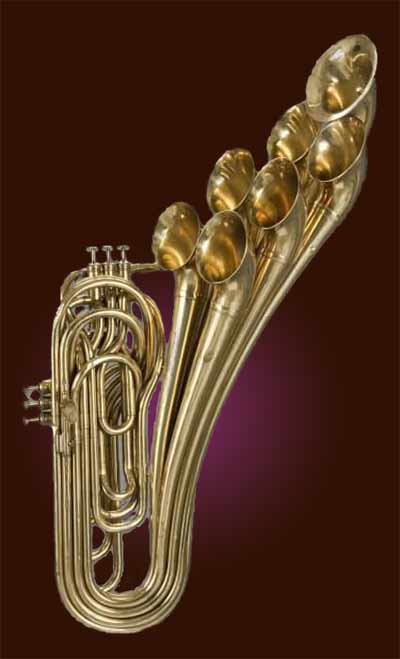
Each valve changes the bell to which the sound goes.
I've been fascinated by this instrument ever since I first saw a drawing of it when I was in Junior High. (So, save you from calculating, that would be about 1960).