Re: Research Sites
This site has been INVALUABLE in my Conn mellophone research:
https://www.saxophone.org/museum/publications
They have a number of catalogs and other ephemera from a number of different Sax manufacturers, but many of these also made brass instruments. Has BY FAR the most on-line Conn catalogs I have been able to find - and the entire catalogs are there, not just the Sax section.
Books
Archives Topics
Research Sites Posts
Research and Taxonomy
Jul 12th, 2008,
Peter's article got me thinking about the fact that there are not that many of us who did research before the days of the Internet, indeed, before computers.
The pace of things was certainly different then. You would look through the periodical indexes and list the publications that contained articles in which you were interested and then submit your list to the librarian. She would then take your list and those of others and disappear into the bowels of the library.
You would then have the chance to glance at the newspaper, or work on that letter you were writing home (remember letters???). Eventually, she would come back with some of the items on your list. The others were "out".
But more than anything else, I remember the joy of discovering some obscure fact or detail that I - at least - had not previously known, and I hoped I would find a way to include it in the paper I was writing.
In a crazed sort of way, it was fun!
Peter, our resident organologist, has been gracious and wrote for us a
Primer for Conducting RESEARCH OF HISTORICAL SUBJECTS
https://www.horn-u-copia.net/research.html
It is our genuine hope that this introduction will serve to both motivate others to do research and to also contribute thoughts, concerns, and ideas on the subject.
(Peter is the author of
Antique Brass Wind Instruments: Identification and Value Guide, and
Antique Woodwind Instruments: An Identification And Price Guide
plus, other articles and publications)
Brasswind Taxonomy- Arnold Myers
Jan 17th, 2005,
Research on Brass Musical Instrument Taxonomy
This research is being carried out in the Faculty of Music and the Department of Physics and Astronomy by Arnold Myers, the Director, and Curator of the University Collection of Historic Musical Instruments.
The project is original research into the identification and classification of brass wind instruments, based on a detailed comparison of internal measurements of instruments and mouthpieces, historical performance traditions and perceived behavior of the instruments in use.
It is a common belief that the difference between one kind of brass musical instrument and another kind is largely a function of bore profile in instrument and mouthpiece. The research is testing this hypothesis and is attempting to identify and quantify a convenient set of parameters for bore profile which would provide a sufficient and unambiguous means of classifying brass instruments. This is being carried out in the acoustics laboratory of the Department of Physics and Astronomy of the University of Edinburgh and in the Edinburgh University Collection of Historic Musical Instruments, which houses a very comprehensive collection of brass instruments.
The bore profiles of a large number of brass instruments of different types is being analysed using state-of-the-art acoustic techniques. The research is drawing on the Edinburgh University Collection of Historic Musical Instruments and other sources of instruments including those believed to be typical of standard models. The research is attempting to bring order to the confused nomenclature of brass instrument types, in particular the instruments developed in the 19th century following the invention of the valve. The research is also attempting to draw some conclusions about different models of nominally similar instruments as used in different places at different historical times. The existence of national schools of instrument design is being examined.
Finally, the research is investigating the possibility of the further invention in the field of brass instrument design: whether the profusion of new instrument patterns in the 19th century exhausted all the possible viable bore profiles, or whether a distinct new type of brass instrument could be made.
Progress so far
There has been progress towards the goal of codifying procedures for the identification and classification of brass instruments, based on a detailed comparison of internal measurements of instruments and mouthpieces, acoustical measurement in the laboratory, historical performance traditions and perceived behavior of the instruments in use.
Measurements have been taken in various collections in Europe and America. A PhD thesis has been successfully completed:
Arnold Myers, Characterization and Taxonomy of Historic Brass Musical Instruments from an Acoustical Standpoint, thesis presented for the Degree of Ph.D., University of Edinburgh, 1998.
Reply #1 - Jan 17th, 2005,
Publications
Arnold Myers and D. Murray Campbell, `Trumpet Design and Acoustical Characteristics’ in Proceedings of Cuivres Anciens Symposium of the Historic Brass Society, Paris, March 1999. New York: Historic Brass Society, [due 2001].
D. Murray Campbell, Jol Gilbert and Arnold Myers, `The Sounding Pitches of Brass Instruments' in Proceedings of the 17th International Congress on Acoustics, Rome, 2-7 September 2001. Rome: 17th ICA, 2001. ISBN 88-88387-03-X, Vol. 4, Wind Instruments session, pp.4-5.
Arnold Myers, `Acoustical Aspects of Preserving Historic Musical Instruments’ in Proceedings of the 17th International Congress on Acoustics, Rome, 2-7 September 2001. Rome: 17th ICA, 2001. ISBN 88-88387-03-X, Vol. 4, Acoustics in the Restoration of Ancient Musical Instruments session, pp.6-7.
Arnold Myers, `Organology: a Position Paper'. Historic Brass Society Journal (ISSN 1045-4616), 2000, 12 pp.viii-xi.
Arnold Myers, `Trombone Designs in the Transition from Early Models to Modern'. In Monika Lustig, ed., Bericht ber das 19 Musikinstrumentenbau-Symposium: Posaunen und Trompeten - Geschichte, Akustik, Spieltechnik; Michaelstein, 20-22 November 1998. (Michaelsteiner Konferenzberichte, Band 60). Blankenburg, Harz: Kloster Michaelstein, 2000. ISBN 3-89512-116-9, pp.39-52.
Arnold Myers and Raymond Parks, `Post-horns, Cornets and Ballad Horns: Catalogue of the Collection Volume 2 Part H Fascicle viii.' Edinburgh: EUCHMI, 2000. ISBN 0 907635 43 1.
Arnold Myers and Raymond Parks, `Althorns, Tenor Horns, and Baritones: Catalogue of the Collection Volume 2 Part H Fascicle ix.' Edinburgh: EUCHMI, 2000. ISBN 0 907635 44 X.
Arnold Myers and Raymond Parks, `Euphoniums and Tubas: Catalogue of the Collection Volume 2 Part H Fascicle x.' Edinburgh: EUCHMI, 2000. ISBN 0 907635 45 8.
D. Murray Campbell, `Intonation et resonances acoustiques des cornets a bouquin et des serpents'. In Laurent Espi and Vincent Gibiat, eds, Colloque acoustique et instruments anciens: factures musiques et science, 17-18 novembre 1998; Paris: Muse de la Musique, 1999, pp.125-137.
Arnold Myers and Raymond Parks, `Trumpets and Trombones: Catalogue of the Collection Volume 2 Part H Fascicle iii, 2nd edition.' Edinburgh: EUCHMI, 1998. ISBN 0 907635 37 7.
Paul Lewis, Arnold Myers, and Raymond Parks, `Horns and Bugles: Catalogue of the Collection Volume 2 Part H Fascicle i, 2nd edition.' Edinburgh: EUCHMI, 1997. ISBN 0 907635 33 4.
Arnold Myers and Raymond Parks, `Large Mouthpieces for Brasswind: Catalogue of the Collection Volume 2 Part H Fascicle v.' Edinburgh: EUCHMI, 1996. ISBN 0 907635 31 8.
Arnold Myers and Raymond Parks, `Small Mouthpieces for Brasswind: Catalogue of the Collection Volume 2 Part H Fascicle iv.' Edinburgh: EUCHMI, 1996. ISBN 0 907635 30 X.
Arnold Myers, `The Horn Function and Brass Instrument Character'. In Stewart Carter, ed., Perspectives in Brass Scholarship: Proceedings of the International Symposium on Historic Brass Instruments, Amherst, 1995; New York: Pendragon, 1997, ISBN 0 945193 97 1, pp.239-262.
David B. Sharp, Arnold Myers and D. Murray Campbell, `Using Pulse Reflectometry to Compare the Evolution of the Cornet and the Trumpet in the 19th and 20th Centuries' In Proceedings of the International Symposium on Musical Acoustics, Edinburgh, 19-22 August 1997: Proceedings of the Institute of Acoustics, 1997, 19 (5), ISBN 1 901656 04 7, pp.541-548.
Frank Tomes and Arnold Myers, `Rudall Carte's Patent Conical Bore Brasswind and Webster Trumpets.' Historic Brass Society Journal (ISSN 1045-4616), 1995, 7 pp.107-122.
David Sharp, Arnold Myers, Raymond Parks, and D. Murray Campbell, `Bore Reconstruction by Pulse Reflectometry and its Potential for the Taxonomy of Brass Instruments.' In Mike Newman, ed., `Proceedings of the 15th International Congress on Acoustics, Trondheim, Norway, 26-30 June 1995', Trondheim: ICA '95, 1995, pp.481-484.
Arnold Myers and Raymond Parks, `How to Measure a Horn'. The Galpin Society Journal (ISSN 0072-0127), 1995, XLVII pp.193-199.
Arnold Myers and D. Murray Campbell, `Approaches to an acoustic taxonomy of brass musical instruments'. Proceedings of the Institute of Acoustics, 1993, 15 (3) pp.697-704.
Did Sax Invent the Saxhorn?: Historic Brass Society and American Musical Instrument Society joint session at `Musical Intersections' Conference, Toronto, 4 November 2000.
Wind the Horn: Investigations into the Bore and Response of Coiled Trompes de Chasse: Physics of Musical Instruments II conference at Institute of Physics Annual Congress, Brighton, 30 March 2000.
Trombone Designs in the Transition from Early Models to Modern: Symposium `Posaunen und Trompeten: Geschicte, Akustik, Spieltechnik', Kloster Michaelstein, Blankenburg, Germany, 20 November 1998.
Instrument Classification and Museum Misinformation: CIMCIM Conference, Melbourne, 12 October 1998.
Early Years of the Modern Trombone - Some Observations: Colloquium on Historical Musical Instrument Acoustics and Technology, meeting organized jointly by the Edinburgh University Collection of Historic Musical Instruments and the Galpin Society, Edinburgh, 22 August 1997.
Taxonomy of the Brass Instrument Mouthpiece: Postgraduate seminar, Faculty of Music, University of Edinburgh, 1997.
Taxonomy of the Brass Instrument Mouthpiece: American Musical Instrument Society, Washington, D.C., 1997.
David B. Sharp, Arnold Myers and D. Murray Campbell, Using Pulse Reflectometry to Compare the Evolution of the Cornet and the Trumpet in the 19th and 20th Centuries: ISMA '97, Edinburgh 22 August 1997.
Arnold Myers (with David Sharp and D. Murray Campbell), Improvements in the Resolution of Bore Reconstruction of Brass Musical Instruments by Pulse Reflectometry: Institute of Physics Annual Congress '96, Telford, 23 April 1996.
Arnold Myers The Horn Function and its Application to the Taxonomy of Brass Instruments: International Symposium of Historic Brass Instruments; Historic Brass Society, Amherst, Massachusetts, 1995
Bore Reconstruction by Pulse Reflectometry and its Potential for the Taxonomy of Brass Instruments: 15th International Congress on Acoustics, Trondheim, Norway, 26-30 June 1995.
Arnold Myers with Raymond Parks, How to Measure a Horn: The Galpin Society and the Historic Brass Society Joint Symposium on Musical Instrument History, Edinburgh, 1994.
Arnold Myers (with Frank Tomes), British Designs for Conical Bore Cornets: The Galpin Society and the Historic Brass Society Joint Symposium on Musical Instrument History, Edinburgh, 1994.
Arnold Myers, Is the Wagner Tuba really a Trumpet? Postgraduate seminar, Faculty of Music, University of Edinburgh, 1991
Reply #3 - Nov 7th, 2005,
One of the most important reasons for creating such a taxonomy is to help facilitate locating properly identified instruments but equally important is to facilitate cataloging and locating publications. Librarians routinely rely upon such taxonomies to catalog books. If an error is created by a researcher, this error might never be eliminated from library catalogs. Such weed citations are the bane of every reference librarian. Another difficulty librarians face is a taxonomy that is so highly specific that even experts are confused.
So, this taxonomy will be a great research resource if/when it is completed.
Reply #4 - Nov 7th, 2005,
It does seem to be an ongoing project, Peter. I suspect the time taken is in direct proportion to obtaining examples of instruments and placing them in context. There are so many horns in so many museums and private collections that were collected because they are, well, collectable, but the problem for guys like Arnold, I think, is that they must be put in context where actual use is concerned.
Museums and private collections are often full of one-offs, and though pretty and desirable for their workmanship and uniqueness, many of them have no indication of general use.
_____________________________________
The trends themselves are a quagmire once you start trying to break things down by country and by region. For example, the US bandmaster and instrument-builder Allen Dodworth is the focus of my attention right now, in part because of his affiliation with Leopold Uhmlann of Vienna. Dodworth's Ebor Cornos are predecessors of Antoine (Adolph or Adolphe) Sax's Eb alto (tenor) and Bb tenor (baritone) Saxhorns. Dodworth patented his OTS design (these instruments included) in 1838, <I><s>[i]</s>before<e>[/i]</e></I> Sax began work on his Saxhorns.
Enter Leopold Uhlmann of Vienna. Uhlmann was given the job, by Dodworth, of making Dodworth's OTS brass for the US market. The problem here is the timeline. Several instrument-builders made instruments for Dodworth and his descendants. I am still trying to get an idea of the movements of both Dodworth and Uhlmann, to try and find out if these two men met face to face, and to try to find out exactly when Uhlmann began making Dodworth instruments.
Here's where things get interesting: If Uhlmann began making Dodworth OTS brass in the 1830's, then there probably will be a US connection to instrument design (and therefore taxonomy) in Europe. What I suspect happened was that Dodworth's horns, made by Uhlmann, became known to Sax, who in turn took Dodworth's OTS design and instruments, created more versions of these horns, and then, sometime around 1845, tried to patent them under his own name.
That Sax was unable to patent the "Saxhorns" is notable. He was taken to court several times, and finally lost in 1855 to Antoine Courtois, who won the right to manufacture "Saxhorns". Until 1855, Sax had the sole right to make these instruments.
He made no effort to try to pull this stunt in the US, I suspect because knowing that the OTS brass had been invented by Dodworth and patented in 1838, he would have been laughed out of court (a place to which he was very familiar over the span of his career as instrument-builder), or worse, sued by Dodworth himself.
Against this backdrop you have Arnold's attempt to create an instrument taxonomy, and I think that this is probably a classic example of "science meets divisive opinionating" by people who presume that they have a vested stake in the outcome of Arnold's research. People have built their careers around studying and classifying brasswinds; many will find that the validity of their life's work is being brought into question.
Also, there are many sub-groups of instruments, some of which have been isolated from outside influence for many years. You have the Cerveny brasswinds which are a family independent from the Saxhorns. You have ethnic versions of well-known instruments that have always differed from the mainstream of design influence.
This all makes for a taxonomic picture as complex of that of living organisms, with dead-ends, curious, hard-to-pin-downside branches and variations, and convergences and divergences whose workings have become obscured because of time itself, and the fact that the details of change occurred in small workshops that kept few or no records.
This latter is certainly true of the connection between Dodworth and Uhlmann.
I'm not sure where Arnold's research is right now, but he did make his findings known a few years ago in New York. I keep checking the Edinburgh University site to see if anything new has been added, but I've seen nothing new since before Arnold's trip to New York.
Here's hoping he'll have a new publication out soon.
Reply #5 - Nov 7th, 2005,
Of course, the opposite is also possible. Dodworth could have been introduced to an OTS design in Europe, maybe by Uhlman or someone else, and then he contracted for the horns to be produced so he could introduce them to the U.S.
Reply #6 - Nov 8th, 2005,
That's a good point, but I've seen no evidence of pre-1850's OTS brass in Europe, and Dodworth himself was making OTS brass in the 1830's. Also, he patented the OTS design in 1838, before he began working with Uhlmann, so I think it's a safe bet that the OTS design was exclusively Dodworth's.
Reply # - Nov 9th, 2005,
An examination of the United States Patent Office online database produced no listing for Allan Dodsworth. The further back one goes in history, the more cumbersome the U.S. Patent Office database becomes. So, it is possible that Dodsworth patent is there. The earliest patent for a brass instrument I've found is Isaac Fiske's valve design.
Reply #8 - Nov 9th, 2005
You're a braver man than I, poking around the US patent office. I've found tracing patents to be a time-consuming and frustrating process.
The easiest way to track down a particular patent would be to go to a resource that cites it, then get in touch with the author.
I'd try Rick Schwartz of The Cornet Compendium, first.
Reply #9 - Nov 10th, 2005
I used to work at one of The United States Patent Office Libraries. So, I have some (and I emphasize the word some) understanding of searching online. One real problem with searching that database is one really needs the patent number for patents issued before the 1970s. Any patents after that time can be searched by keywords. So, no matter how I misspell Dodsworth, that is not a term that can be searched for in the current database. The USPO just does not have the money to do a retrospective cataloging project of old patents. Searching can be done by another means by category, such as CC/84. That is the class heading for all musical instruments. That is how I found the Fiske patent. Any number that begins with the letter D is for a design and is not a patent as such. The lower the number, the older the patent. These are the best suggestions for searching the USPO database I can provide. A few websites do list patent numbers, but I'm still researching that topic.
By the way, that should have been CCL/84 not CC/84 if searching the United States Patent Office database.
Reply #11 - Nov 10th, 2005,
Maybe you should post a How-To lesson on doing patent searches, then, Peter.
It would be nice to have a well-laid-out, properly cross-referenced and user-friendly database of musical instrument patents and patent sketches, for all countries. Just tackling a project like that would be a full-time job.
Reply #14 - Dec 3rd, 2005,
A few thoughts on taxonomy for brass instruments.
To revisit the term tuba, one must remember that the term has a history. I'm not sure when it first appeared in print (I need to check the O.E.D. to see if that is any help). I have a copy of an August Pollmann catalog printed in 1894. On page 81 is the caption "The Pollmann circular style Tuba." This instrument is then identified later the same page as a helicon. On page 104 is a bell up B flat euponium followed by a bell up bass on page 105 described as a contra bass. In other words, the term tuba was not used consistently in the catalog to describe either a size or body design. I suspect that researchers out there will insist that there is no such thing as a helicon, just a helicon-shape bass. So, to try and add some clarity, maybe we should: research what terms appear in the wholesale catalogs; decide what generic terms to avoid using; and include a date when defining and using terms. One only needs to look at the Old English Dictionary to see that definitions change over time. This makes producing a taxonomy a real challenge for musical instruments, especially as researchers need to use terms more specifically than the public at large. That is why I liked to use abbreviations in my brass book to describe instrument configurations, such as TARV BF. If the information I had access to for that book had included fundamental pitches for the bass instruments, the question of baritone verses tenor might have been clarified. Other examples are lurking in the darkness to terrorize researchers.
Clear as mud.
Re: Brasswind Taxonomy- Arnold Myers
Reply #15 - Dec 3rd, 2005
You're exactly right, Peter, the term "tuba" is used inconsistently, even today. The oldest usage I'm aware of is the Roman "tuba curva", but that is another instrument entirely.
The generic collective term for bass brass is "basses", whilst the term tuba, in strict usage, is used to describe first the Moritz/Weiprecht instrument (sp?) and instruments that follow that design.
The problem, however, is that that design itself has changed over the years. If you look at the shape of old 19th century tubas, they do not look like the modern type made by, say, Besson and Courtois.
However, there is a system for describing the modern instruments that is based upon what has survived and sets the modern canon. That is: the instruments with that tell-tale bore profile with the fat, wide bell is the modern tuba, which includes the Besson and Courtois tuba, and euphoniums and Eb alto brass of that same design (the Cerveny).
Taxonomy-wise, though, we must do our homework, and note every design, and try to figure out where the branches occur. When and where we don't know, there must necessarily be question marks, and bald patches on our heads from scratching them.
There is also the matter of companies like Cerveny, Courtois and Besson. Many of these companies have been around for hundreds of years, so what they're doing has to be considered, although most of the guys who presently own and work at these companies know very little, if anything, about their history.
Reply #16 - Dec 3rd, 2005,
Having studied the taxonomy of shells and insects (long story), the use of generic terms within a taxonomy is to be avoided. That is why Curt Sach developed his flawed taxonomy using Latin. The only taxonomy I've seen that makes any improvements on Sach is found in the catalog of the Kuniatchi (spelling?) Museum. There, the catalog uses English rather than Latin. In doing so, it makes it somewhat more accessible to novices.
I am still of the opinion that we don't need to be able to parse each instrument into the smallest of sub-sub species. Rather we need to be able to create a robust system that allows for corrections, growth, and flexibility; one that will also allow for quick identification of types. After all, the goal of a taxonomy must be usability. The system should be able to handle keyword searching. This will help in describing standard and variant types. With the advent of the computer and our ability to configure data any way we can imagine, surely a descriptive system will be more useful than a tree structure. Don't get me wrong, I'm all for tree structures. That structure helps to identify possible flaws in a system. While I am just putting out ideas, to complete the system I propose, we would first have to either define a set of terms or assemble one. That project should not be too difficult, i.e., bell forward, wide bore, etc. To some degree we have such an ad-hoc system. Does anyone know of an online dictionary of terms for brass instruments? Do we need to create one?
Reply #17 - Dec 4th, 2005,
For the sake of accuracy, I think we need both a descriptive and a tree system, Peter. No system is perfect, and there are times when descriptions inadvertently illuminate flaws in the visual process, and there are times when seeing things laid out illuminates flaws in reasoning.
As to parsing instruments- we must take the physical record on its own terms. If that means being faced with parsing to the nth degree, then we must suck it up and do the work. I confess the sheer amount of work needed to organize our understanding of cornets and tubas makes me queasy, but I didn't get into this without expecting a challenge.
As to dictionaries and brasswind terms, part of the purpose of the brasswind taxonomy project headed by Arnold Myers is clarification in terms of classification, and that process is ongoing.
This means that we are faced with sifting through the terms already in use and deciding which we are to use.
Where it gets problematic is in the grey areas between one instrument and another. For example, there are true tubas and there are bass saxhorns, and there are myriad instruments in-between, just as there are small, medium, and large-bore Bb tenor saxhorns, and euphoniums, and there are also myriad instruments that fall between each discreet category.
Methinks we'll be making much use of the words "kind of", "sort of", "almost", "would be such-and-such a horn, except", "looks like", "sounds like", "would be related, except", "is a perfect example, except for the", and so on.
Reply #18 - Dec 4th, 2005,
Yikes! Buzz words!! The use of "sort of" and related terms is avoided in library science by simply using terms that are broad enough to provide inclusion but specific enough to provide clarity. It is kind of like walking in a mine field in the dark with your eyes closed. You try not to make mistakes from which you cannot recover.
So, what must a brass taxonomy include?
Begin with the most obvious - and least likely to be altered and go through to the most specific.
Has Arnold provided any insight into the taxonomy he is developing? Can we be of assistance in the matter?
Reply #19 - Dec 4th, 2005,
One lucky thing about brasswind taxonomy is that it is a bit like shapes in nature vis-a-vis fractals: there only are a very few shapes out of which all brasswinds are assembled.
I invite your input and help. If you're willing, I would very much like to see you pursue a parallel descriptive system. This is Kenton's site, so of course his is always the final say, but to the best of my knowledge, he seems to think the taxonomy angle should be pursued.
Cross-referencing is the most powerful tool of modern everything, and I was thinking that both a tree and a descriptive system would be best. The problem is, I don't know the first thing about computers. I'm a late comer to the computer age.
The thing is, what I would like to see is a fusion that includes both. Trees are short on information, because information clutters them up, spoiling the effect. Information, on the other hand, lacks the impact and clarity of a visual aid. This may be asking the impossible, and may be impractical, but what I would <I><s>[i]</s>like<e>[/i]</e></I> to see is a descriptive section with highlighted areas you can click on that take you to the relevant portion of the tree section. The reverse of this would be a highlighted tree section you can click on that takes you to the detailed information.
Another matter I keep forgetting to bring up is the matter of who actually <I><s>[i]</s>played<e>[/i]</e></I> the instruments. It's a big part of the picture. The early modern trumpet was not used in the classical world until around the time of the First World War, for example. Another example is the mellophone from circa 1890 to circa 1930. For some reason the mellophone seems to have been the perennial favorite of black, not white musicians (who played the alto horn during this same period). Certainly, the photographic record points in this direction, although it is entirely possible that this perception is skewed <I><s>[i]</s>by<e>[/i]</e></I> the photographic record: but it's a question I personally would like an answer to. Kenton provided another revelation in the form of certain of the Sousaphones that were heavy tanks used in early jazz bands that were not made for marching purposes. Not being a bass brass player, or familiar with this instrument, I would never have guessed such a thing.
Reply #20 - Dec 5th, 2005,
Seriously though, your desire to capture information about performance would be possible with the aid of someone who knows how to set up a dynamic database. The real problem in doing that is not the programming but acquiring the data. Usage is VERY important, but simply cannot be determined by examining a horn. All too often, that is all that is available. Only a limited number of locations have even the smallest number of documents.
When I was in graduate school, I developed a tree structure for all musical instruments. In doing so, I came to realize what I've said before on the boards. Taxonomy has two uses: to identify an instrument and to bring together information about an instrument.
The musical instrument person will have different requirements than a librarian cataloging a book. Musicians with an instrument in hand will often have different information than the librarian holding a document. The musician could use a question-and-answer method to identify an instrument (What is its size? Does it have valves, and if so, how many? If not, does it have keys and if so, how many? What is it made of? Which way does the bell point? Based upon construction, can a date be determined? etc.).
The librarian would need a keyword system and possibly a picture gallery for gathering information (as I basically used in my book about antique brass.) I am not advocating two databases, but rather an ability to use the database in different ways. One might be able to click on a button for Identifying instruments in hand and a button for Identifying printed material. Different information would then be presented. Populating the database, however, would require many nimble hands typing and scanning documents.
So, to begin by taking a small bite at this subject, I propose two concurrent data gathering projects. First could we assemble a list of key terms for which information is needed? Second, could I get feedback on my ideas about people who own trade catalogs searching them for key terms like mellophone, tuba, etc.? I simply don't have enough original research material to start a second database for usage of brass terms.
I checked the OED and came up with too little information to be of help in such a project. (I'm not even sure what key terms would need to be in the list.) That important publication is sadly too general for this use. The OED is currently the only resource that even comes close to documenting this sort of information.
Reply #21 - Dec 5th, 2005,
I think we're going to have to come up with terms and hash them out, Peter.
This was the first wall I ran into when it came to a taxonomic explanation of the mellophone. Like the "tuba", there is simply no such instrument. "Mellophone" is really a catch-all term used to describe any number of instruments, not all of which are related.
The modern instrument is certainly not directly related to the original, and the original itself is a knock-off of a knock-off. Even the original is not truly original, because it was a circular variation on other pre-existing designs.
The shape of an instrument is often deceiving. In the 19th century, alto/tenor F/Eb instruments came in a dizzying array of shapes and configurations, but on the inside, it was only the same few ideas tried over and over ad nauseam.
And in the world of taxonomy there are trees, and there are trees. There are the instruments, and then there are the underlying principles, which are comprehensible only to a physicist. I'm still trying to get my head around the physics of mouthpieces, and open- and closed-end tubes.
It is possible to nail certain things down in strict, unambiguous terms. For instance, the tenor cor can be demonstrated to be a tenor cornopean for two reasons: 1) the interior design is the same, and 2) both were made by the same person; so it is possible in that way to establish that an individual considered a single idea and principle in two forms.
Knowing whom is also very important, but it is blamed hard to establish. Uhlmann of Vienna made Dodworth's Ebor Cornos, but I can find no record of the two men having ever interacted. I do not know if Uhlmann influenced the design of OTS brass familiar to us today, and I do not know what connection there was between Uhlmann and Sax- which is of vital importance because it seems obvious that Sax appropriated the Dodworth/Uhlmann OTS design (patented in 1838) when he began work on his Saxhorns in 1844. Uhlmann (1806-1878) was a famous and influential instrument builder/designer in his own right. At present I do not know how much, if any, contact there was between himself and Sax.
Reply #22 - Dec 6th, 2005,
"Keep it simple" is a mantra that needs to be followed in making a workable taxonomy. If we must rely upon the advanced knowledge of a physicist to determine if a horn is a whatsaphone or a whoseaphone we will never be able to use the taxonomy. First, let's develop the structure and then work on the footnotes, hybrids, and cross references. Trying to build the taxonomy from the footnotes up will never work.
Being concerned with looks rather than sound seems to make sense. Many horns are simply not in playable condition. But by examining key features (mentioned in my last posting), we stand a better chance in creating a taxonomy.
I emailed Myers to offer my modest assistance yesterday. Maybe he will find my comments of value.
Jul 12th, 2008,
Peter's article got me thinking about the fact that there are not that many of us who did research before the days of the Internet, indeed, before computers.
The pace of things was certainly different then. You would look through the periodical indexes and list the publications that contained articles in which you were interested and then submit your list to the librarian. She would then take your list and those of others and disappear into the bowels of the library.
You would then have the chance to glance at the newspaper, or work on that letter you were writing home (remember letters???). Eventually, she would come back with some of the items on your list. The others were "out".
But more than anything else, I remember the joy of discovering some obscure fact or detail that I - at least - had not previously known, and I hoped I would find a way to include it in the paper I was writing.
In a crazed sort of way, it was fun!
Peter, our resident organologist, has been gracious and wrote for us a
Primer for Conducting RESEARCH OF HISTORICAL SUBJECTS
https://www.horn-u-copia.net/research.html
It is our genuine hope that this introduction will serve to both motivate others to do research and to also contribute thoughts, concerns, and ideas on the subject.
(Peter is the author of
Antique Brass Wind Instruments: Identification and Value Guide, and
Antique Woodwind Instruments: An Identification And Price Guide
plus, other articles and publications)
Brasswind Taxonomy- Arnold Myers
Jan 17th, 2005,
Research on Brass Musical Instrument Taxonomy
This research is being carried out in the Faculty of Music and the Department of Physics and Astronomy by Arnold Myers, the Director, and Curator of the University Collection of Historic Musical Instruments.
The project is original research into the identification and classification of brass wind instruments, based on a detailed comparison of internal measurements of instruments and mouthpieces, historical performance traditions and perceived behavior of the instruments in use.
It is a common belief that the difference between one kind of brass musical instrument and another kind is largely a function of bore profile in instrument and mouthpiece. The research is testing this hypothesis and is attempting to identify and quantify a convenient set of parameters for bore profile which would provide a sufficient and unambiguous means of classifying brass instruments. This is being carried out in the acoustics laboratory of the Department of Physics and Astronomy of the University of Edinburgh and in the Edinburgh University Collection of Historic Musical Instruments, which houses a very comprehensive collection of brass instruments.
The bore profiles of a large number of brass instruments of different types is being analysed using state-of-the-art acoustic techniques. The research is drawing on the Edinburgh University Collection of Historic Musical Instruments and other sources of instruments including those believed to be typical of standard models. The research is attempting to bring order to the confused nomenclature of brass instrument types, in particular the instruments developed in the 19th century following the invention of the valve. The research is also attempting to draw some conclusions about different models of nominally similar instruments as used in different places at different historical times. The existence of national schools of instrument design is being examined.
Finally, the research is investigating the possibility of the further invention in the field of brass instrument design: whether the profusion of new instrument patterns in the 19th century exhausted all the possible viable bore profiles, or whether a distinct new type of brass instrument could be made.
Progress so far
There has been progress towards the goal of codifying procedures for the identification and classification of brass instruments, based on a detailed comparison of internal measurements of instruments and mouthpieces, acoustical measurement in the laboratory, historical performance traditions and perceived behavior of the instruments in use.
Measurements have been taken in various collections in Europe and America. A PhD thesis has been successfully completed:
Arnold Myers, Characterization and Taxonomy of Historic Brass Musical Instruments from an Acoustical Standpoint, thesis presented for the Degree of Ph.D., University of Edinburgh, 1998.
Reply #1 - Jan 17th, 2005,
Publications
Arnold Myers and D. Murray Campbell, `Trumpet Design and Acoustical Characteristics’ in Proceedings of Cuivres Anciens Symposium of the Historic Brass Society, Paris, March 1999. New York: Historic Brass Society, [due 2001].
D. Murray Campbell, Jol Gilbert and Arnold Myers, `The Sounding Pitches of Brass Instruments' in Proceedings of the 17th International Congress on Acoustics, Rome, 2-7 September 2001. Rome: 17th ICA, 2001. ISBN 88-88387-03-X, Vol. 4, Wind Instruments session, pp.4-5.
Arnold Myers, `Acoustical Aspects of Preserving Historic Musical Instruments’ in Proceedings of the 17th International Congress on Acoustics, Rome, 2-7 September 2001. Rome: 17th ICA, 2001. ISBN 88-88387-03-X, Vol. 4, Acoustics in the Restoration of Ancient Musical Instruments session, pp.6-7.
Arnold Myers, `Organology: a Position Paper'. Historic Brass Society Journal (ISSN 1045-4616), 2000, 12 pp.viii-xi.
Arnold Myers, `Trombone Designs in the Transition from Early Models to Modern'. In Monika Lustig, ed., Bericht ber das 19 Musikinstrumentenbau-Symposium: Posaunen und Trompeten - Geschichte, Akustik, Spieltechnik; Michaelstein, 20-22 November 1998. (Michaelsteiner Konferenzberichte, Band 60). Blankenburg, Harz: Kloster Michaelstein, 2000. ISBN 3-89512-116-9, pp.39-52.
Arnold Myers and Raymond Parks, `Post-horns, Cornets and Ballad Horns: Catalogue of the Collection Volume 2 Part H Fascicle viii.' Edinburgh: EUCHMI, 2000. ISBN 0 907635 43 1.
Arnold Myers and Raymond Parks, `Althorns, Tenor Horns, and Baritones: Catalogue of the Collection Volume 2 Part H Fascicle ix.' Edinburgh: EUCHMI, 2000. ISBN 0 907635 44 X.
Arnold Myers and Raymond Parks, `Euphoniums and Tubas: Catalogue of the Collection Volume 2 Part H Fascicle x.' Edinburgh: EUCHMI, 2000. ISBN 0 907635 45 8.
D. Murray Campbell, `Intonation et resonances acoustiques des cornets a bouquin et des serpents'. In Laurent Espi and Vincent Gibiat, eds, Colloque acoustique et instruments anciens: factures musiques et science, 17-18 novembre 1998; Paris: Muse de la Musique, 1999, pp.125-137.
Arnold Myers and Raymond Parks, `Trumpets and Trombones: Catalogue of the Collection Volume 2 Part H Fascicle iii, 2nd edition.' Edinburgh: EUCHMI, 1998. ISBN 0 907635 37 7.
Paul Lewis, Arnold Myers, and Raymond Parks, `Horns and Bugles: Catalogue of the Collection Volume 2 Part H Fascicle i, 2nd edition.' Edinburgh: EUCHMI, 1997. ISBN 0 907635 33 4.
Arnold Myers and Raymond Parks, `Large Mouthpieces for Brasswind: Catalogue of the Collection Volume 2 Part H Fascicle v.' Edinburgh: EUCHMI, 1996. ISBN 0 907635 31 8.
Arnold Myers and Raymond Parks, `Small Mouthpieces for Brasswind: Catalogue of the Collection Volume 2 Part H Fascicle iv.' Edinburgh: EUCHMI, 1996. ISBN 0 907635 30 X.
Arnold Myers, `The Horn Function and Brass Instrument Character'. In Stewart Carter, ed., Perspectives in Brass Scholarship: Proceedings of the International Symposium on Historic Brass Instruments, Amherst, 1995; New York: Pendragon, 1997, ISBN 0 945193 97 1, pp.239-262.
David B. Sharp, Arnold Myers and D. Murray Campbell, `Using Pulse Reflectometry to Compare the Evolution of the Cornet and the Trumpet in the 19th and 20th Centuries' In Proceedings of the International Symposium on Musical Acoustics, Edinburgh, 19-22 August 1997: Proceedings of the Institute of Acoustics, 1997, 19 (5), ISBN 1 901656 04 7, pp.541-548.
Frank Tomes and Arnold Myers, `Rudall Carte's Patent Conical Bore Brasswind and Webster Trumpets.' Historic Brass Society Journal (ISSN 1045-4616), 1995, 7 pp.107-122.
David Sharp, Arnold Myers, Raymond Parks, and D. Murray Campbell, `Bore Reconstruction by Pulse Reflectometry and its Potential for the Taxonomy of Brass Instruments.' In Mike Newman, ed., `Proceedings of the 15th International Congress on Acoustics, Trondheim, Norway, 26-30 June 1995', Trondheim: ICA '95, 1995, pp.481-484.
Arnold Myers and Raymond Parks, `How to Measure a Horn'. The Galpin Society Journal (ISSN 0072-0127), 1995, XLVII pp.193-199.
Arnold Myers and D. Murray Campbell, `Approaches to an acoustic taxonomy of brass musical instruments'. Proceedings of the Institute of Acoustics, 1993, 15 (3) pp.697-704.
Did Sax Invent the Saxhorn?: Historic Brass Society and American Musical Instrument Society joint session at `Musical Intersections' Conference, Toronto, 4 November 2000.
Wind the Horn: Investigations into the Bore and Response of Coiled Trompes de Chasse: Physics of Musical Instruments II conference at Institute of Physics Annual Congress, Brighton, 30 March 2000.
Trombone Designs in the Transition from Early Models to Modern: Symposium `Posaunen und Trompeten: Geschicte, Akustik, Spieltechnik', Kloster Michaelstein, Blankenburg, Germany, 20 November 1998.
Instrument Classification and Museum Misinformation: CIMCIM Conference, Melbourne, 12 October 1998.
Early Years of the Modern Trombone - Some Observations: Colloquium on Historical Musical Instrument Acoustics and Technology, meeting organized jointly by the Edinburgh University Collection of Historic Musical Instruments and the Galpin Society, Edinburgh, 22 August 1997.
Taxonomy of the Brass Instrument Mouthpiece: Postgraduate seminar, Faculty of Music, University of Edinburgh, 1997.
Taxonomy of the Brass Instrument Mouthpiece: American Musical Instrument Society, Washington, D.C., 1997.
David B. Sharp, Arnold Myers and D. Murray Campbell, Using Pulse Reflectometry to Compare the Evolution of the Cornet and the Trumpet in the 19th and 20th Centuries: ISMA '97, Edinburgh 22 August 1997.
Arnold Myers (with David Sharp and D. Murray Campbell), Improvements in the Resolution of Bore Reconstruction of Brass Musical Instruments by Pulse Reflectometry: Institute of Physics Annual Congress '96, Telford, 23 April 1996.
Arnold Myers The Horn Function and its Application to the Taxonomy of Brass Instruments: International Symposium of Historic Brass Instruments; Historic Brass Society, Amherst, Massachusetts, 1995
Bore Reconstruction by Pulse Reflectometry and its Potential for the Taxonomy of Brass Instruments: 15th International Congress on Acoustics, Trondheim, Norway, 26-30 June 1995.
Arnold Myers with Raymond Parks, How to Measure a Horn: The Galpin Society and the Historic Brass Society Joint Symposium on Musical Instrument History, Edinburgh, 1994.
Arnold Myers (with Frank Tomes), British Designs for Conical Bore Cornets: The Galpin Society and the Historic Brass Society Joint Symposium on Musical Instrument History, Edinburgh, 1994.
Arnold Myers, Is the Wagner Tuba really a Trumpet? Postgraduate seminar, Faculty of Music, University of Edinburgh, 1991
Reply #3 - Nov 7th, 2005,
One of the most important reasons for creating such a taxonomy is to help facilitate locating properly identified instruments but equally important is to facilitate cataloging and locating publications. Librarians routinely rely upon such taxonomies to catalog books. If an error is created by a researcher, this error might never be eliminated from library catalogs. Such weed citations are the bane of every reference librarian. Another difficulty librarians face is a taxonomy that is so highly specific that even experts are confused.
So, this taxonomy will be a great research resource if/when it is completed.
Reply #4 - Nov 7th, 2005,
It does seem to be an ongoing project, Peter. I suspect the time taken is in direct proportion to obtaining examples of instruments and placing them in context. There are so many horns in so many museums and private collections that were collected because they are, well, collectable, but the problem for guys like Arnold, I think, is that they must be put in context where actual use is concerned.
Museums and private collections are often full of one-offs, and though pretty and desirable for their workmanship and uniqueness, many of them have no indication of general use.
_____________________________________
The trends themselves are a quagmire once you start trying to break things down by country and by region. For example, the US bandmaster and instrument-builder Allen Dodworth is the focus of my attention right now, in part because of his affiliation with Leopold Uhmlann of Vienna. Dodworth's Ebor Cornos are predecessors of Antoine (Adolph or Adolphe) Sax's Eb alto (tenor) and Bb tenor (baritone) Saxhorns. Dodworth patented his OTS design (these instruments included) in 1838, <I><s>[i]</s>before<e>[/i]</e></I> Sax began work on his Saxhorns.
Enter Leopold Uhlmann of Vienna. Uhlmann was given the job, by Dodworth, of making Dodworth's OTS brass for the US market. The problem here is the timeline. Several instrument-builders made instruments for Dodworth and his descendants. I am still trying to get an idea of the movements of both Dodworth and Uhlmann, to try and find out if these two men met face to face, and to try to find out exactly when Uhlmann began making Dodworth instruments.
Here's where things get interesting: If Uhlmann began making Dodworth OTS brass in the 1830's, then there probably will be a US connection to instrument design (and therefore taxonomy) in Europe. What I suspect happened was that Dodworth's horns, made by Uhlmann, became known to Sax, who in turn took Dodworth's OTS design and instruments, created more versions of these horns, and then, sometime around 1845, tried to patent them under his own name.
That Sax was unable to patent the "Saxhorns" is notable. He was taken to court several times, and finally lost in 1855 to Antoine Courtois, who won the right to manufacture "Saxhorns". Until 1855, Sax had the sole right to make these instruments.
He made no effort to try to pull this stunt in the US, I suspect because knowing that the OTS brass had been invented by Dodworth and patented in 1838, he would have been laughed out of court (a place to which he was very familiar over the span of his career as instrument-builder), or worse, sued by Dodworth himself.
Against this backdrop you have Arnold's attempt to create an instrument taxonomy, and I think that this is probably a classic example of "science meets divisive opinionating" by people who presume that they have a vested stake in the outcome of Arnold's research. People have built their careers around studying and classifying brasswinds; many will find that the validity of their life's work is being brought into question.
Also, there are many sub-groups of instruments, some of which have been isolated from outside influence for many years. You have the Cerveny brasswinds which are a family independent from the Saxhorns. You have ethnic versions of well-known instruments that have always differed from the mainstream of design influence.
This all makes for a taxonomic picture as complex of that of living organisms, with dead-ends, curious, hard-to-pin-downside branches and variations, and convergences and divergences whose workings have become obscured because of time itself, and the fact that the details of change occurred in small workshops that kept few or no records.
This latter is certainly true of the connection between Dodworth and Uhlmann.
I'm not sure where Arnold's research is right now, but he did make his findings known a few years ago in New York. I keep checking the Edinburgh University site to see if anything new has been added, but I've seen nothing new since before Arnold's trip to New York.
Here's hoping he'll have a new publication out soon.
Reply #5 - Nov 7th, 2005,
Of course, the opposite is also possible. Dodworth could have been introduced to an OTS design in Europe, maybe by Uhlman or someone else, and then he contracted for the horns to be produced so he could introduce them to the U.S.
Reply #6 - Nov 8th, 2005,
That's a good point, but I've seen no evidence of pre-1850's OTS brass in Europe, and Dodworth himself was making OTS brass in the 1830's. Also, he patented the OTS design in 1838, before he began working with Uhlmann, so I think it's a safe bet that the OTS design was exclusively Dodworth's.
Reply # - Nov 9th, 2005,
An examination of the United States Patent Office online database produced no listing for Allan Dodsworth. The further back one goes in history, the more cumbersome the U.S. Patent Office database becomes. So, it is possible that Dodsworth patent is there. The earliest patent for a brass instrument I've found is Isaac Fiske's valve design.
Reply #8 - Nov 9th, 2005
You're a braver man than I, poking around the US patent office. I've found tracing patents to be a time-consuming and frustrating process.
The easiest way to track down a particular patent would be to go to a resource that cites it, then get in touch with the author.
I'd try Rick Schwartz of The Cornet Compendium, first.
Reply #9 - Nov 10th, 2005
I used to work at one of The United States Patent Office Libraries. So, I have some (and I emphasize the word some) understanding of searching online. One real problem with searching that database is one really needs the patent number for patents issued before the 1970s. Any patents after that time can be searched by keywords. So, no matter how I misspell Dodsworth, that is not a term that can be searched for in the current database. The USPO just does not have the money to do a retrospective cataloging project of old patents. Searching can be done by another means by category, such as CC/84. That is the class heading for all musical instruments. That is how I found the Fiske patent. Any number that begins with the letter D is for a design and is not a patent as such. The lower the number, the older the patent. These are the best suggestions for searching the USPO database I can provide. A few websites do list patent numbers, but I'm still researching that topic.
By the way, that should have been CCL/84 not CC/84 if searching the United States Patent Office database.
Reply #11 - Nov 10th, 2005,
Maybe you should post a How-To lesson on doing patent searches, then, Peter.
It would be nice to have a well-laid-out, properly cross-referenced and user-friendly database of musical instrument patents and patent sketches, for all countries. Just tackling a project like that would be a full-time job.
Reply #14 - Dec 3rd, 2005,
A few thoughts on taxonomy for brass instruments.
To revisit the term tuba, one must remember that the term has a history. I'm not sure when it first appeared in print (I need to check the O.E.D. to see if that is any help). I have a copy of an August Pollmann catalog printed in 1894. On page 81 is the caption "The Pollmann circular style Tuba." This instrument is then identified later the same page as a helicon. On page 104 is a bell up B flat euponium followed by a bell up bass on page 105 described as a contra bass. In other words, the term tuba was not used consistently in the catalog to describe either a size or body design. I suspect that researchers out there will insist that there is no such thing as a helicon, just a helicon-shape bass. So, to try and add some clarity, maybe we should: research what terms appear in the wholesale catalogs; decide what generic terms to avoid using; and include a date when defining and using terms. One only needs to look at the Old English Dictionary to see that definitions change over time. This makes producing a taxonomy a real challenge for musical instruments, especially as researchers need to use terms more specifically than the public at large. That is why I liked to use abbreviations in my brass book to describe instrument configurations, such as TARV BF. If the information I had access to for that book had included fundamental pitches for the bass instruments, the question of baritone verses tenor might have been clarified. Other examples are lurking in the darkness to terrorize researchers.
Clear as mud.
Re: Brasswind Taxonomy- Arnold Myers
Reply #15 - Dec 3rd, 2005
You're exactly right, Peter, the term "tuba" is used inconsistently, even today. The oldest usage I'm aware of is the Roman "tuba curva", but that is another instrument entirely.
The generic collective term for bass brass is "basses", whilst the term tuba, in strict usage, is used to describe first the Moritz/Weiprecht instrument (sp?) and instruments that follow that design.
The problem, however, is that that design itself has changed over the years. If you look at the shape of old 19th century tubas, they do not look like the modern type made by, say, Besson and Courtois.
However, there is a system for describing the modern instruments that is based upon what has survived and sets the modern canon. That is: the instruments with that tell-tale bore profile with the fat, wide bell is the modern tuba, which includes the Besson and Courtois tuba, and euphoniums and Eb alto brass of that same design (the Cerveny).
Taxonomy-wise, though, we must do our homework, and note every design, and try to figure out where the branches occur. When and where we don't know, there must necessarily be question marks, and bald patches on our heads from scratching them.
There is also the matter of companies like Cerveny, Courtois and Besson. Many of these companies have been around for hundreds of years, so what they're doing has to be considered, although most of the guys who presently own and work at these companies know very little, if anything, about their history.
Reply #16 - Dec 3rd, 2005,
Having studied the taxonomy of shells and insects (long story), the use of generic terms within a taxonomy is to be avoided. That is why Curt Sach developed his flawed taxonomy using Latin. The only taxonomy I've seen that makes any improvements on Sach is found in the catalog of the Kuniatchi (spelling?) Museum. There, the catalog uses English rather than Latin. In doing so, it makes it somewhat more accessible to novices.
I am still of the opinion that we don't need to be able to parse each instrument into the smallest of sub-sub species. Rather we need to be able to create a robust system that allows for corrections, growth, and flexibility; one that will also allow for quick identification of types. After all, the goal of a taxonomy must be usability. The system should be able to handle keyword searching. This will help in describing standard and variant types. With the advent of the computer and our ability to configure data any way we can imagine, surely a descriptive system will be more useful than a tree structure. Don't get me wrong, I'm all for tree structures. That structure helps to identify possible flaws in a system. While I am just putting out ideas, to complete the system I propose, we would first have to either define a set of terms or assemble one. That project should not be too difficult, i.e., bell forward, wide bore, etc. To some degree we have such an ad-hoc system. Does anyone know of an online dictionary of terms for brass instruments? Do we need to create one?
Reply #17 - Dec 4th, 2005,
For the sake of accuracy, I think we need both a descriptive and a tree system, Peter. No system is perfect, and there are times when descriptions inadvertently illuminate flaws in the visual process, and there are times when seeing things laid out illuminates flaws in reasoning.
As to parsing instruments- we must take the physical record on its own terms. If that means being faced with parsing to the nth degree, then we must suck it up and do the work. I confess the sheer amount of work needed to organize our understanding of cornets and tubas makes me queasy, but I didn't get into this without expecting a challenge.
As to dictionaries and brasswind terms, part of the purpose of the brasswind taxonomy project headed by Arnold Myers is clarification in terms of classification, and that process is ongoing.
This means that we are faced with sifting through the terms already in use and deciding which we are to use.
Where it gets problematic is in the grey areas between one instrument and another. For example, there are true tubas and there are bass saxhorns, and there are myriad instruments in-between, just as there are small, medium, and large-bore Bb tenor saxhorns, and euphoniums, and there are also myriad instruments that fall between each discreet category.
Methinks we'll be making much use of the words "kind of", "sort of", "almost", "would be such-and-such a horn, except", "looks like", "sounds like", "would be related, except", "is a perfect example, except for the", and so on.
Reply #18 - Dec 4th, 2005,
Yikes! Buzz words!! The use of "sort of" and related terms is avoided in library science by simply using terms that are broad enough to provide inclusion but specific enough to provide clarity. It is kind of like walking in a mine field in the dark with your eyes closed. You try not to make mistakes from which you cannot recover.
So, what must a brass taxonomy include?
Begin with the most obvious - and least likely to be altered and go through to the most specific.
Has Arnold provided any insight into the taxonomy he is developing? Can we be of assistance in the matter?
Reply #19 - Dec 4th, 2005,
One lucky thing about brasswind taxonomy is that it is a bit like shapes in nature vis-a-vis fractals: there only are a very few shapes out of which all brasswinds are assembled.
I invite your input and help. If you're willing, I would very much like to see you pursue a parallel descriptive system. This is Kenton's site, so of course his is always the final say, but to the best of my knowledge, he seems to think the taxonomy angle should be pursued.
Cross-referencing is the most powerful tool of modern everything, and I was thinking that both a tree and a descriptive system would be best. The problem is, I don't know the first thing about computers. I'm a late comer to the computer age.
The thing is, what I would like to see is a fusion that includes both. Trees are short on information, because information clutters them up, spoiling the effect. Information, on the other hand, lacks the impact and clarity of a visual aid. This may be asking the impossible, and may be impractical, but what I would <I><s>[i]</s>like<e>[/i]</e></I> to see is a descriptive section with highlighted areas you can click on that take you to the relevant portion of the tree section. The reverse of this would be a highlighted tree section you can click on that takes you to the detailed information.
Another matter I keep forgetting to bring up is the matter of who actually <I><s>[i]</s>played<e>[/i]</e></I> the instruments. It's a big part of the picture. The early modern trumpet was not used in the classical world until around the time of the First World War, for example. Another example is the mellophone from circa 1890 to circa 1930. For some reason the mellophone seems to have been the perennial favorite of black, not white musicians (who played the alto horn during this same period). Certainly, the photographic record points in this direction, although it is entirely possible that this perception is skewed <I><s>[i]</s>by<e>[/i]</e></I> the photographic record: but it's a question I personally would like an answer to. Kenton provided another revelation in the form of certain of the Sousaphones that were heavy tanks used in early jazz bands that were not made for marching purposes. Not being a bass brass player, or familiar with this instrument, I would never have guessed such a thing.
Reply #20 - Dec 5th, 2005,
Seriously though, your desire to capture information about performance would be possible with the aid of someone who knows how to set up a dynamic database. The real problem in doing that is not the programming but acquiring the data. Usage is VERY important, but simply cannot be determined by examining a horn. All too often, that is all that is available. Only a limited number of locations have even the smallest number of documents.
When I was in graduate school, I developed a tree structure for all musical instruments. In doing so, I came to realize what I've said before on the boards. Taxonomy has two uses: to identify an instrument and to bring together information about an instrument.
The musical instrument person will have different requirements than a librarian cataloging a book. Musicians with an instrument in hand will often have different information than the librarian holding a document. The musician could use a question-and-answer method to identify an instrument (What is its size? Does it have valves, and if so, how many? If not, does it have keys and if so, how many? What is it made of? Which way does the bell point? Based upon construction, can a date be determined? etc.).
The librarian would need a keyword system and possibly a picture gallery for gathering information (as I basically used in my book about antique brass.) I am not advocating two databases, but rather an ability to use the database in different ways. One might be able to click on a button for Identifying instruments in hand and a button for Identifying printed material. Different information would then be presented. Populating the database, however, would require many nimble hands typing and scanning documents.
So, to begin by taking a small bite at this subject, I propose two concurrent data gathering projects. First could we assemble a list of key terms for which information is needed? Second, could I get feedback on my ideas about people who own trade catalogs searching them for key terms like mellophone, tuba, etc.? I simply don't have enough original research material to start a second database for usage of brass terms.
I checked the OED and came up with too little information to be of help in such a project. (I'm not even sure what key terms would need to be in the list.) That important publication is sadly too general for this use. The OED is currently the only resource that even comes close to documenting this sort of information.
Reply #21 - Dec 5th, 2005,
I think we're going to have to come up with terms and hash them out, Peter.
This was the first wall I ran into when it came to a taxonomic explanation of the mellophone. Like the "tuba", there is simply no such instrument. "Mellophone" is really a catch-all term used to describe any number of instruments, not all of which are related.
The modern instrument is certainly not directly related to the original, and the original itself is a knock-off of a knock-off. Even the original is not truly original, because it was a circular variation on other pre-existing designs.
The shape of an instrument is often deceiving. In the 19th century, alto/tenor F/Eb instruments came in a dizzying array of shapes and configurations, but on the inside, it was only the same few ideas tried over and over ad nauseam.
And in the world of taxonomy there are trees, and there are trees. There are the instruments, and then there are the underlying principles, which are comprehensible only to a physicist. I'm still trying to get my head around the physics of mouthpieces, and open- and closed-end tubes.
It is possible to nail certain things down in strict, unambiguous terms. For instance, the tenor cor can be demonstrated to be a tenor cornopean for two reasons: 1) the interior design is the same, and 2) both were made by the same person; so it is possible in that way to establish that an individual considered a single idea and principle in two forms.
Knowing whom is also very important, but it is blamed hard to establish. Uhlmann of Vienna made Dodworth's Ebor Cornos, but I can find no record of the two men having ever interacted. I do not know if Uhlmann influenced the design of OTS brass familiar to us today, and I do not know what connection there was between Uhlmann and Sax- which is of vital importance because it seems obvious that Sax appropriated the Dodworth/Uhlmann OTS design (patented in 1838) when he began work on his Saxhorns in 1844. Uhlmann (1806-1878) was a famous and influential instrument builder/designer in his own right. At present I do not know how much, if any, contact there was between himself and Sax.
Reply #22 - Dec 6th, 2005,
"Keep it simple" is a mantra that needs to be followed in making a workable taxonomy. If we must rely upon the advanced knowledge of a physicist to determine if a horn is a whatsaphone or a whoseaphone we will never be able to use the taxonomy. First, let's develop the structure and then work on the footnotes, hybrids, and cross references. Trying to build the taxonomy from the footnotes up will never work.
Being concerned with looks rather than sound seems to make sense. Many horns are simply not in playable condition. But by examining key features (mentioned in my last posting), we stand a better chance in creating a taxonomy.
I emailed Myers to offer my modest assistance yesterday. Maybe he will find my comments of value.
Research Sites https://www.brasshistory.net is Jon Patton's site
https://www.pocketcornets.com/ is niche but useful, especially as the Nick DeCarlis Vintage Cornets site is down
General Searches:
The New Langwill Index
www.horn-u-copia.net
www.archive.org for many city directories & phone books
www.catalog.hathitrust.org for city directories & other public documents
www.google.com for listings of city directories & other books Google has scanned
www.olddirectorysearch.com for city directories
www.latinamericanstudies.org/us-maps-directories-htm for more city directories
www.nmmusd.org for the National Music Museum
www.mugwamps.com/AmerInstMkr.htmlfor American Fretted Instrument Makers
www.arcade-museum.com to search their scans of Presto & Music Trade Review magazines
www.trumpet-history.com for Ron Berndt’s history site
www.trademarks.justia.com for finding music related trademarks in the US, 1892-2018
www.robbstewart.com for great research & photos of old brass
www.vintagecornets.com for Nick’s great site of old brass & pocket cornets
www.horncollector.com for Eric Totman’s collection and Schreiber info
www.lipscomb.edu/windbandhistory for the history of 19th century US bands
www.collectionsdumusee.philharmonicdeparis.fr/vents-inocntournables.aspx for the Paris museum
www.euchmi.ed.ca.uk/ubia.html for the Edinburgh Univ brass collection
www.specialcollections.le.ac.uk/cdm/search/collection for the London Museum brass
www.bcu.ac.uk/conservatoire/research/hic/the-collection for the Birmingham museum
www.mfa.org/node/9485 for brass at the Boston Museum of Fine Arts
www.idnc.library.illinois.edu for Illinois newspapers
New York research sites:
http://www.nyhistoricnewspapers.org to search by county and years for newspapers
http://www.fultonhistory.com/Fulton.html to do a word search in many NY & PA newspapers
http://www.castlegardens.org for finding immigrants to NYC in the 19th century
http://www.jon-n-bevliles.net/RAILROAD/Sanborn/Sanborn-newyork.html for Sanborn maps
http://www.digitalcollections.nypl.org for the NY Public Library collection including city directories
http://www.idnc.library.illinois.edu for digital copies of the NY Clipper newspaper
www3.libraryweb.org/lh.aspx?id=1105 for directories of Rochester, NY
Specific Cities:
https://eu.wikipedia.org/wiki/Boston_Directory for Boston info
www.aomol.msa.maryland.gov/html/officials.html for Baltimore info
www.baltimorecityhistory.net/baltimore-city-directories/ for Baltimore
www.baltimoregeneologysociety.org/BaltoDir.html for Baltimore directories
www.virtuallibrary.cincinnatilibrary.org for Cincinnati
www.digital.cincinnatilibrary.org for Wurlitzer Catalogs & Sanborn Maps
www.sfpl.org for San Francisco info
https://www.pocketcornets.com/ is niche but useful, especially as the Nick DeCarlis Vintage Cornets site is down
General Searches:
The New Langwill Index
www.horn-u-copia.net
www.archive.org for many city directories & phone books
www.catalog.hathitrust.org for city directories & other public documents
www.google.com for listings of city directories & other books Google has scanned
www.olddirectorysearch.com for city directories
www.latinamericanstudies.org/us-maps-directories-htm for more city directories
www.nmmusd.org for the National Music Museum
www.mugwamps.com/AmerInstMkr.htmlfor American Fretted Instrument Makers
www.arcade-museum.com to search their scans of Presto & Music Trade Review magazines
www.trumpet-history.com for Ron Berndt’s history site
www.trademarks.justia.com for finding music related trademarks in the US, 1892-2018
www.robbstewart.com for great research & photos of old brass
www.vintagecornets.com for Nick’s great site of old brass & pocket cornets
www.horncollector.com for Eric Totman’s collection and Schreiber info
www.lipscomb.edu/windbandhistory for the history of 19th century US bands
www.collectionsdumusee.philharmonicdeparis.fr/vents-inocntournables.aspx for the Paris museum
www.euchmi.ed.ca.uk/ubia.html for the Edinburgh Univ brass collection
www.specialcollections.le.ac.uk/cdm/search/collection for the London Museum brass
www.bcu.ac.uk/conservatoire/research/hic/the-collection for the Birmingham museum
www.mfa.org/node/9485 for brass at the Boston Museum of Fine Arts
www.idnc.library.illinois.edu for Illinois newspapers
New York research sites:
http://www.nyhistoricnewspapers.org to search by county and years for newspapers
http://www.fultonhistory.com/Fulton.html to do a word search in many NY & PA newspapers
http://www.castlegardens.org for finding immigrants to NYC in the 19th century
http://www.jon-n-bevliles.net/RAILROAD/Sanborn/Sanborn-newyork.html for Sanborn maps
http://www.digitalcollections.nypl.org for the NY Public Library collection including city directories
http://www.idnc.library.illinois.edu for digital copies of the NY Clipper newspaper
www3.libraryweb.org/lh.aspx?id=1105 for directories of Rochester, NY
Specific Cities:
https://eu.wikipedia.org/wiki/Boston_Directory for Boston info
www.aomol.msa.maryland.gov/html/officials.html for Baltimore info
www.baltimorecityhistory.net/baltimore-city-directories/ for Baltimore
www.baltimoregeneologysociety.org/BaltoDir.html for Baltimore directories
www.virtuallibrary.cincinnatilibrary.org for Cincinnati
www.digital.cincinnatilibrary.org for Wurlitzer Catalogs & Sanborn Maps
www.sfpl.org for San Francisco info
Since Jim Donaldson's passing, the Schilke Loyalist/Trumpet Gearhead were mirrored/picked up by EverythingTrumpet:
https://www.everythingtrumpet.com/gearhead/
https://www.everythingtrumpet.com/schilke/ is Schilke Loyalist
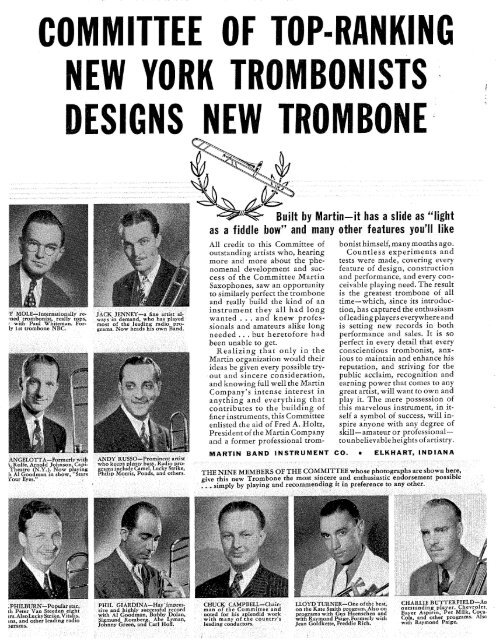
I still can't stand that Martin Committee "design committee" post saying Bach, Benge, and Reynolds were participants...the actual Committee seemed to just be an input/endorsement board [I think my higher-resolution copies are on a different drive]:
https://www.everythingtrumpet.com/gearhead/
https://www.everythingtrumpet.com/schilke/ is Schilke Loyalist
I still can't stand that Martin Committee "design committee" post saying Bach, Benge, and Reynolds were participants...the actual Committee seemed to just be an input/endorsement board [I think my higher-resolution copies are on a different drive]:

In the late 1930s the company put together a process to design instrument by Committee, and named as such. The trumpet, which became the most notable of the Committee models, was designed by Renold Schilke, Vincent Bach, Elden Benge, Foster Reynolds, and an unnamed local player.2
Therein lies the problem. That paragraph isn't really true, and it seems to have been a misconception only put to bed by the period advertisement basically stating a committee of artists agrees this trumpet is good. I suppose it could be modeled after Ron Berndt's seen below?
I'm not a great communicator, so I'll defer to Ron Berndt's interpretation, but I always found it odd about the Martin Committee [of which the pre-war design was a bit different than post-war, and I recall a Martin ad from late in WW2 stating they were working on new Committee models in preparation for peacetime manufacturing]...
Schilke was a bit of a freelance at the time, and Martin benefitted from his design input ideas. He was initially working with what he had seen [i.e. reverse-leadpipe] before branching out into original research, and he had also assisted his friend Elden Benge with setting up trumpet production.
Benge was developing his take on the Besson design, and everyone else had been established in the industry for a time. They were competitors who, even if they had some fraternal sense of "community" or such, probably wouldn't have cooperated on a design for an entirely different company.
I've seen some opinions that Schilke claimed sole credit as a matter of ego and pride, not sharing the credit for petty reasons, but I think he was the main designer and coordinator, taking ownership of a project only he was really designing for.
Ron puts it thus:
"When the Holton Cannon was introduced, Renold Schilke was a featured “child prodigy” (he was actually in his mid-teens) performing with the Holton Elkhorn Band. During this time, he learned the skills of a machinist, gun smith and brass instrument craftsman apprenticing to the workers at the Holton plant. When the Llewellyn was added, Schilke was in Belgium studying the science of brass instrument acoustics. Upon his return, Schilke began applying a scientific approach to the refinement of trumpet design, particularly in the area of leadpipe taper and positioning elements of construction that introduce turbulence away from the most critical nodal points acoustically.
This then leads to the popular myth, that the Committee was designed by a workgroup of all of the great designers of the day. Viewed rationally, one may easily recognize that these designers were competitors and would have had no motivation to improve the design of Martin’s product. Their input, rather, was as it had been with the first Martin trumpets that included elements from leading makers, a matter of reverse-engineering the competition. In truth, Schilke was the only designer on the actual team."
https://trumpet-history.com/Martin%20Trumpet%20Models.pdf
Jon Patton says the same [doesn't really help that they both say the same thing using the same source, but they're more eloquent in phrasing it]:
https://www.brasshistory.net/Martin%20Trumpet%20Committee.pdf
Therein lies the problem. That paragraph isn't really true, and it seems to have been a misconception only put to bed by the period advertisement basically stating a committee of artists agrees this trumpet is good. I suppose it could be modeled after Ron Berndt's seen below?
I'm not a great communicator, so I'll defer to Ron Berndt's interpretation, but I always found it odd about the Martin Committee [of which the pre-war design was a bit different than post-war, and I recall a Martin ad from late in WW2 stating they were working on new Committee models in preparation for peacetime manufacturing]...
Schilke was a bit of a freelance at the time, and Martin benefitted from his design input ideas. He was initially working with what he had seen [i.e. reverse-leadpipe] before branching out into original research, and he had also assisted his friend Elden Benge with setting up trumpet production.
Benge was developing his take on the Besson design, and everyone else had been established in the industry for a time. They were competitors who, even if they had some fraternal sense of "community" or such, probably wouldn't have cooperated on a design for an entirely different company.
I've seen some opinions that Schilke claimed sole credit as a matter of ego and pride, not sharing the credit for petty reasons, but I think he was the main designer and coordinator, taking ownership of a project only he was really designing for.
Ron puts it thus:
"When the Holton Cannon was introduced, Renold Schilke was a featured “child prodigy” (he was actually in his mid-teens) performing with the Holton Elkhorn Band. During this time, he learned the skills of a machinist, gun smith and brass instrument craftsman apprenticing to the workers at the Holton plant. When the Llewellyn was added, Schilke was in Belgium studying the science of brass instrument acoustics. Upon his return, Schilke began applying a scientific approach to the refinement of trumpet design, particularly in the area of leadpipe taper and positioning elements of construction that introduce turbulence away from the most critical nodal points acoustically.
This then leads to the popular myth, that the Committee was designed by a workgroup of all of the great designers of the day. Viewed rationally, one may easily recognize that these designers were competitors and would have had no motivation to improve the design of Martin’s product. Their input, rather, was as it had been with the first Martin trumpets that included elements from leading makers, a matter of reverse-engineering the competition. In truth, Schilke was the only designer on the actual team."
https://trumpet-history.com/Martin%20Trumpet%20Models.pdf
Jon Patton says the same [doesn't really help that they both say the same thing using the same source, but they're more eloquent in phrasing it]:
https://www.brasshistory.net/Martin%20Trumpet%20Committee.pdf
National Music Museum:
https://www.nmmusd.org/
https://www.nmmusd.org/